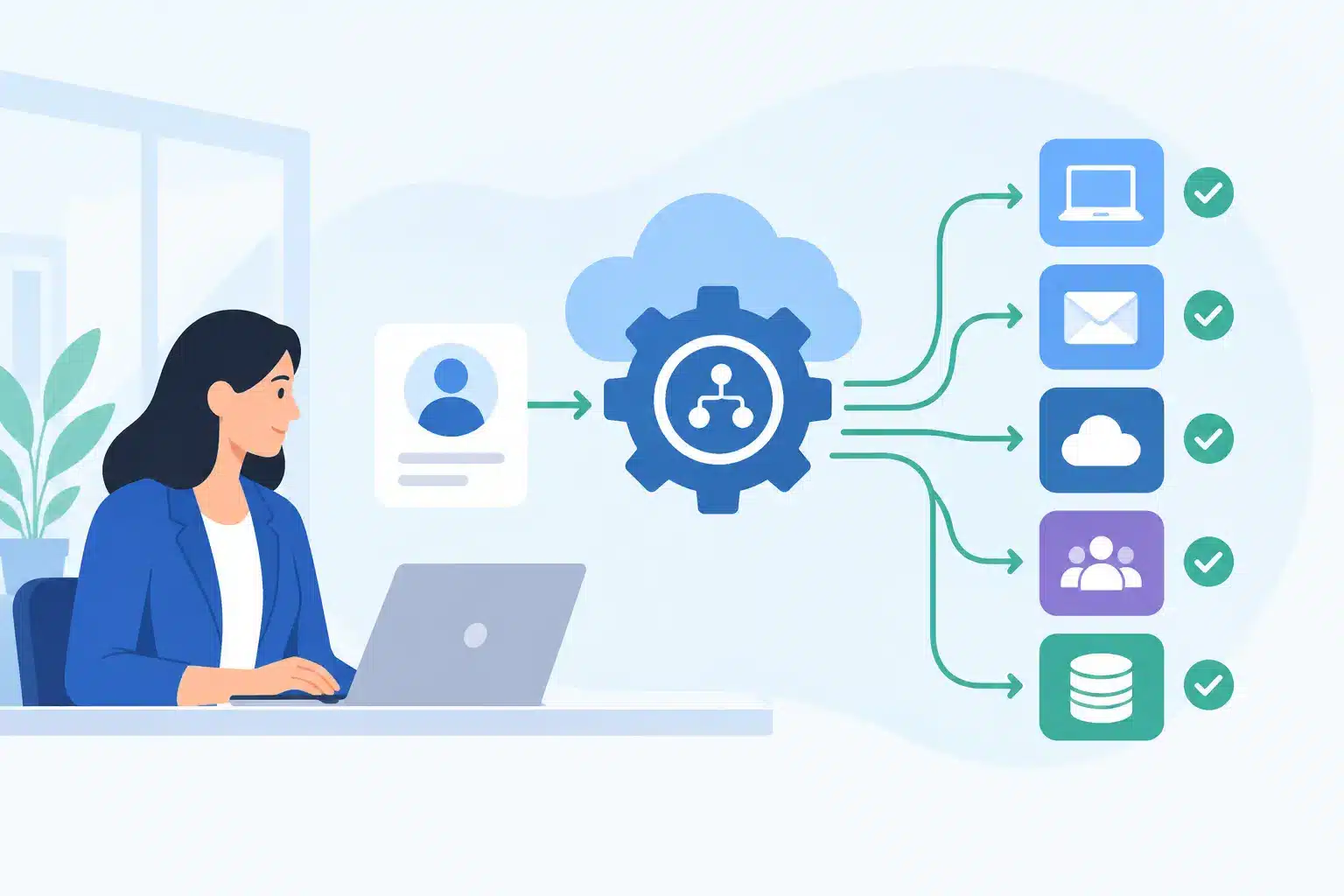
A terminated employee can lose single sign-on access in minutes and still retain permissions inside a finance application, a cloud console, or a legacy database. That gap is where the IGA vs IAM distinction becomes operationally significant. IAM gets identities connected to the resources they need. IGA establishes the control system that proves those permissions remain justified, approved, and appropriate over time.
For enterprise security teams, this is not a debate over competing product categories. IAM and IGA address different parts of the same access-control problem. Treating IGA as an optional add-on after an IAM deployment often leaves organizations with fast provisioning but weak evidence, unmanaged exceptions, and excessive access that accumulates quietly.
IGA vs IAM: The Core Difference
Identity and Access Management, or IAM, is the broader discipline of managing digital identities and controlling authentication and access. It commonly includes identity directories, single sign-on, multifactor authentication, federation, lifecycle provisioning, and access policies. IAM answers immediate questions: Who is this user? Can they authenticate? Which application can they enter?
Identity Governance and Administration, or IGA, applies policy, accountability, and oversight to access decisions across the identity lifecycle. It focuses on who should have access, who approved it, whether the access is still necessary, and how the organization can demonstrate control to auditors and regulators.
The overlap matters. Both disciplines can provision and remove access. The difference is the depth of governance around that action. An IAM workflow might create an account when HR records a new hire. An IGA program adds birthright access rules, role models, segregation-of-duties controls, approval routing, entitlement ownership, periodic access certifications, and a defensible audit trail.
IAM is often visible to employees because it shapes their sign-in experience. IGA is often most visible to application owners, managers, compliance teams, and identity administrators because it governs the decisions behind access. Both are essential, but they solve different failure modes.
What IAM Controls Day to Day
IAM provides the access foundation that keeps business operations moving. A mature IAM environment centralizes authentication, enforces multifactor authentication, connects authoritative identity sources, and automates common joiner-mover-leaver events. These capabilities reduce password exposure, simplify user access, and remove manual administration from high-volume workflows.
For example, when an employee changes departments, IAM can use HR attributes to update group membership or provision baseline access. When a contractor’s engagement ends, IAM can disable the identity at the primary access layer. In cloud-heavy environments, IAM also helps enforce conditional access policies based on device posture, location, risk, and authentication context.
These controls are foundational, but they do not automatically answer whether the employee still needs access to a sensitive payroll folder, an ERP transaction code, or a production support role. That question requires governance data, assigned ownership, and a recurring decision process.
IAM can also become fragmented. Organizations may run one platform for workforce authentication, another for customer identity, separate privileged access controls, and individual provisioning connectors for business systems. Without governance across those systems, administrators can execute access changes efficiently while security leadership lacks a reliable view of accumulated entitlement risk.
What IGA Adds to Access Control
IGA turns access management into a measurable control process. It connects identity data, application entitlements, business roles, ownership assignments, approval policy, and certification activity into a governed operating model.
A strong IGA implementation establishes authoritative sources for identity attributes and defines how access should be requested, approved, provisioned, reviewed, and removed. It does not assume that an access decision made six months ago is still valid. Instead, it provides mechanisms to challenge access at defined intervals and revoke permissions that no longer serve a business purpose.
The most consequential IGA capabilities typically include access request and approval workflows, role and entitlement management, access certification campaigns, separation-of-duties analysis, policy enforcement, and audit reporting. These functions help organizations control access at a level of detail that traditional authentication and provisioning tools may not provide.
Consider a finance user who requests access to create vendors. The IAM system may be able to provision the requested entitlement. IGA evaluates whether the request conflicts with existing permissions, routes it to the accountable owner, records the justification, and ensures the entitlement appears in future certification reviews. If the user also has authority to approve payments, a segregation-of-duties policy can block or escalate the request before a material control failure occurs.
That is the practical value of IGA: it reduces the distance between a business decision and a technical permission.
Why Provisioning Alone Is Not Governance
Automated provisioning is valuable, but automation without policy can distribute excessive access faster. Organizations often discover this after a merger, ERP transformation, cloud migration, or audit finding exposes years of unmanaged group membership and direct application entitlements.
Three conditions commonly create the problem. First, access models become too dependent on individual exceptions rather than defined roles. Second, application owners are not clearly assigned or are unable to review entitlement data in business terms. Third, leaver and mover processes disable primary accounts but miss downstream access, shared accounts, service accounts, or local application roles.
IGA addresses these conditions by forcing ownership and review into the process. However, it is not a cure for poor identity data. If HR records are incomplete, contractor populations are unmanaged, or applications cannot expose meaningful entitlement data, an IGA platform will surface those weaknesses rather than hide them.
That is a productive outcome, but it requires executive support. Governance programs often fail when teams treat them as a compliance exercise owned solely by audit. The relevant stakeholders include HR, security, IT, application owners, business managers, risk teams, and the owners of privileged and nonhuman identities.
Where PAM, Machine Identities, and AI Agents Fit
IGA and IAM do not replace Privileged Access Management. PAM controls elevated access to critical systems, manages credential exposure, and can enforce session-level controls. IGA governs who is eligible for privileged access, which approvals are required, how long access should remain active, and how that access is reviewed.
The same principle now applies to service accounts, certificates, workload identities, API credentials, and AI agents. These identities may not appear in HR systems, yet they can access sensitive data, execute workflows, and create material operational risk. IAM provides the authentication and authorization mechanisms. IGA establishes accountability, ownership, lifecycle control, and periodic review.
AI agents make the gap more urgent. An agent may operate with delegated permissions across collaboration platforms, customer data, code repositories, and internal systems. Security teams need to know who authorized those scopes, what the agent can do, when its access expires, and whether its permissions remain aligned to its purpose. Governance cannot be limited to human users when nonhuman identities increasingly drive business processes.
Choosing the Right Starting Point
The right investment sequence depends on current risk and operational maturity. An organization with weak authentication, unmanaged directories, and no reliable lifecycle process should stabilize IAM fundamentals first. Multifactor authentication, centralized identity sources, account lifecycle automation, and basic access policies create the control plane that IGA depends on.
An organization with established authentication and provisioning but recurring audit findings, manual recertifications, role sprawl, or access approval bottlenecks should prioritize IGA. The goal is not to deploy every governance feature at once. Start with the applications and identities that carry the greatest financial, regulatory, operational, or privileged-access risk.
A practical program usually begins by establishing a clean identity data model, naming accountable application and entitlement owners, and connecting a limited set of high-value systems. From there, access request workflows, certification campaigns, and policy controls can be expanded in controlled phases. This approach produces useful evidence early while avoiding a multi-year effort built on unverified role assumptions.
There are trade-offs. Highly granular role models can improve control but become expensive to maintain. Broad birthright access improves onboarding speed but can increase exposure. Frequent certifications improve review cadence but may create approval fatigue if reviewers receive poor-quality data. The answer is not maximum process. It is a control model proportionate to risk, supported by reliable data and clear accountability.
Treat IGA as an Operating Discipline
IGA is not finished when connectors are live and the first certification campaign closes. Applications change, employees move, cloud permissions evolve, and business units create new exceptions. Governance must be monitored, tuned, and operated as part of the identity security program.
That operating discipline includes tracking stale accounts, unowned entitlements, overdue reviews, policy violations, failed provisioning events, and access exceptions. It also means reviewing whether access decisions are understandable to business owners. If a manager cannot determine what an entitlement allows, the organization does not have meaningful governance, even if the certification was technically completed.
For enterprises evaluating IGA vs IAM, the most useful question is not which platform to buy. Ask where critical access is being granted without durable evidence of need, ownership, and review. That answer identifies the next control gap to close and gives the identity program a practical path toward stronger, more defensible access governance.