Last updated: July 2026
Organizations rarely fail at identity because they lack tools. They fail because those tools operate in silos, with no central authority setting policy, assigning ownership, or measuring outcomes. IAM governance is what fixes that. This guide explains what IAM governance is, the framework and committee behind it, the best practices that make it work in 2026, and how it relates to identity governance and administration.
What is IAM governance?
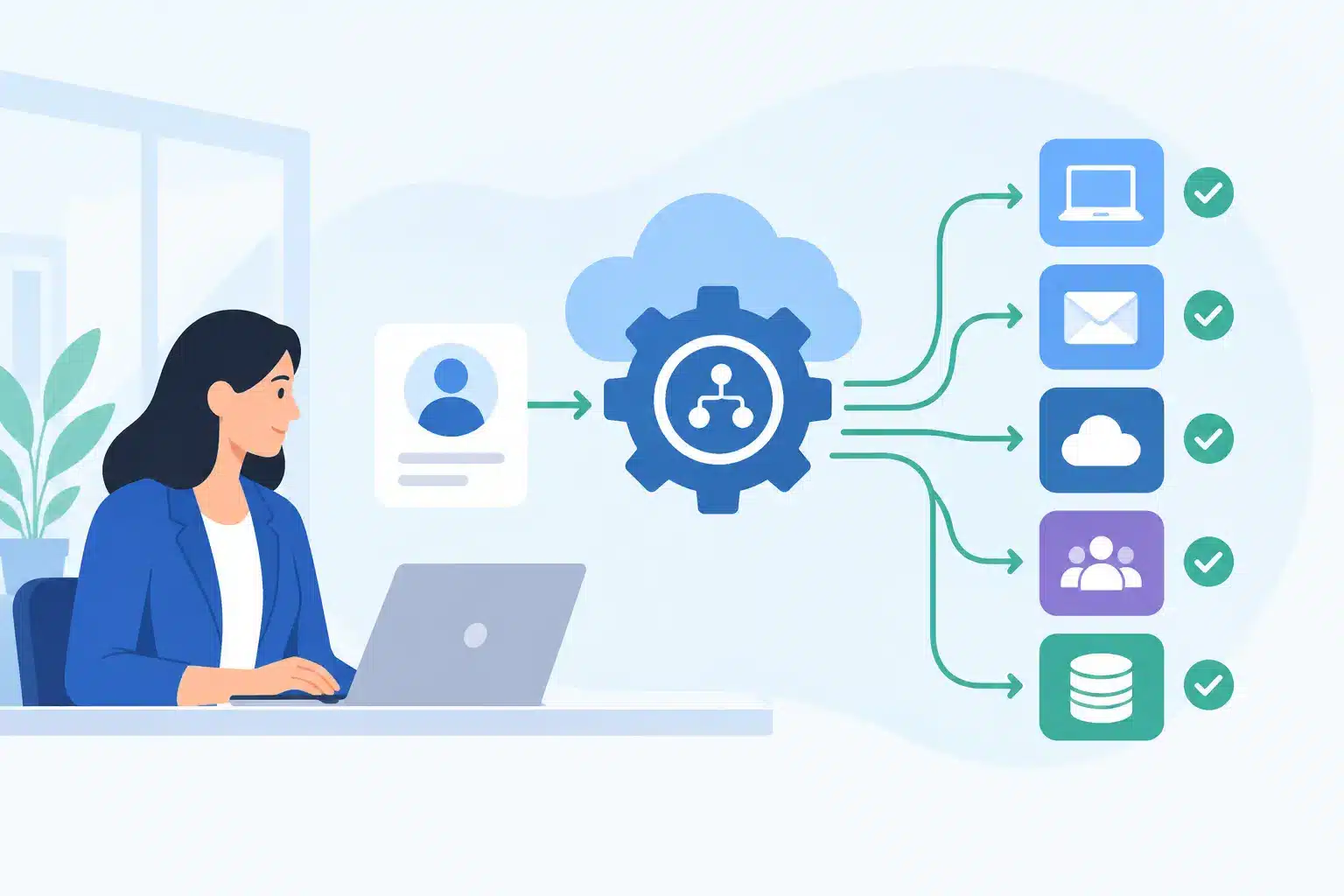
IAM governance is the framework of policies, ownership, and oversight that ensures an organization’s identity and access management program is consistent, compliant, and aligned with business objectives. It is the rulebook and the accountability structure that sits above the day-to-day mechanics of authentication and provisioning, defining how identities are created, managed, reviewed, and retired across the enterprise.
Where IAM handles the operational question of who can access what, IAM governance handles the strategic questions around it: who owns the policy, who is accountable when it fails, how access decisions are made consistently at scale, and how the whole program proves it is working. Without this layer, IAM initiatives become fragmented, producing inconsistent policies, conflicting departmental priorities, and controls that drift out of date.
IAM governance is closely tied to identity governance and administration (IGA). IAM governance sets the enterprise-wide policy and accountability model; IGA provides the platform and processes, access reviews, certifications, segregation of duties, that put that governance into practice.
Governance is one of the four pillars of IAM
IAM is commonly described through four pillars, and governance is one of them. The four pillars are authentication (verifying identity), authorization (enforcing what an identity can access), administration (managing accounts and entitlements), and governance (ensuring all of it stays aligned with policy and compliance).
Governance is the pillar that holds the other three accountable. Authentication and authorization control access in the moment, and administration executes changes, but without governance there is nothing ensuring those actions follow consistent rules, get reviewed, and produce evidence. This is also captured in the “four A’s” of IAM, authentication, authorization, administration, and audit, where audit and governance together provide the oversight and accountability that make the program defensible.
The components of an IAM governance framework
A functioning IAM governance framework combines several elements into a single, coherent model rather than a collection of disconnected controls.
- Policy development. Clear, documented rules for provisioning, authentication, authorization, and auditing, reviewed regularly to stay relevant. This is the foundation that makes access decisions repeatable and auditable.
- Ownership and accountability. Defined responsibilities for who can create, modify, and approve changes to identity data and policy, so accountability is never ambiguous.
- Role-based access control (RBAC). Access granted by role rather than individually, so policy can be applied and reviewed at the level of job function.
- Segregation of duties (SoD). Rules preventing any single identity from holding conflicting permissions that could enable fraud.
- Access certification. Periodic reviews validating that permissions still match business need.
- Automation. Consistent enforcement of policy at scale by automating access decisions, workflows, and revocation across systems.
- Monitoring and audit. Continuous logging and reporting that both detect anomalies and demonstrate compliance to regulators.
The recurring lesson from 2026 research is that most organizations fail at identity governance not because they lack these components, but because the components operate in silos instead of as a single lifecycle.
The IAM governance committee
One structural element separates mature IAM programs from struggling ones: a governance committee. Establishing an IAM governance committee elevates identity management from a purely operational task to a strategic enterprise program. This cross-functional body ensures IAM policies align with business objectives, regulatory requirements such as GDPR and HIPAA, and security goals.
The reason this matters is practical. According to Gartner, IAM projects frequently suffer from excessive time and cost unless organizations adopt a program-centric approach. A governance committee provides the authority and cross-functional collaboration, spanning security, IT, HR, compliance, and business units, that a program-centric approach requires. Without it, identity decisions get made in isolation and pull in different directions.
IAM governance best practices for 2026
Effective IAM governance in 2026 rests on a consistent set of disciplines.
Start with discovery and ownership. The most successful modernizations begin with two parallel steps: discovering and auditing every existing account, permission, and policy, since you cannot secure what you cannot see, and establishing the governance structure to own it.
Enforce least privilege and Zero Trust. Grant only the access each identity needs, and verify every request continuously rather than trusting based on network location. One study found that, on average, 85% of credentials had not been used in the past 90 days, each an unnecessary attack vector that least-privilege governance would remove.
Automate the lifecycle. Automating provisioning, modification, and deprovisioning eliminates orphaned accounts and privilege creep, and closes access gaps the moment they appear.
Govern non-human and AI agent identities. The 2026 shift is toward a governance-first strategy that treats machine and AI agent identities as first-class. A simple test decides whether an identity needs governing: can it access data, store data, or reach the internet? If yes, it needs ownership, least-privilege policy, and monitoring, even if it is a bot or an agent. Best practice for agentic AI includes purpose-bound, temporary credentials that are automatically revoked once a task completes.
Measure and review continuously. Track measurable outcomes, maintain a multi-year roadmap, and run regular audits so governance evolves with the business rather than freezing at deployment.
IAM governance vs IGA: how they relate
These terms are closely related and often used together. IAM governance is the broad discipline of governing the entire identity program: policy, ownership, oversight, and accountability across authentication, authorization, and administration. IGA (identity governance and administration) is the category of platforms and processes that operationalize governance, running the access reviews, certifications, SoD enforcement, and lifecycle workflows.
Put simply, IAM governance is the strategy and accountability model; IGA is how you execute it. A strong IAM governance framework sets the rules and assigns ownership, and an IGA platform enforces those rules consistently and produces the evidence. Neither delivers full value alone: governance without an execution platform stays theoretical, and an IGA platform without a governance framework becomes a tool nobody is accountable for.
How to strengthen your IAM governance
Building effective IAM governance follows a clear sequence. Establish a governance committee and a documented policy model so access decisions are consistent and accountable. Discover and inventory every identity, human and non-human, to create an accurate baseline. Automate the lifecycle and certification so policy is enforced at scale rather than by memory. Extend governance to machine and AI agent identities with clear ownership. And measure outcomes continuously so the program keeps pace with change.
Technology enables all of this, but structure and expertise deliver it. The organizations that succeed pair a clear governance model with the integration work to enforce it across a real, messy estate. A dedicated identity governance and administration solution combined with expert integration turns IAM governance from a policy document into a control that consistently reduces risk and passes audits.
Frequently asked questions
What is IAM governance?
IAM governance is the framework of policies, ownership, and oversight that keeps an identity and access management program consistent, compliant, and aligned with business goals. It defines how identities are created, managed, reviewed, and retired across the enterprise.
What are the four pillars of IAM?
The four pillars of IAM are authentication (verifying identity), authorization (enforcing access), administration (managing accounts), and governance (keeping it all aligned with policy and compliance). Governance is the pillar that holds the others accountable.
What is the difference between IAM governance and IGA?
IAM governance is the strategy and accountability model for the whole identity program. IGA (identity governance and administration) is the category of platforms and processes that operationalize it through access reviews, certifications, and lifecycle workflows. Governance sets the rules; IGA enforces them.
Why do organizations need an IAM governance committee?
Because without a central body, identity decisions get made in silos, producing inconsistent policy and conflicting priorities. A cross-functional committee aligns IAM with business, security, and compliance goals, and Gartner notes IAM projects overrun on time and cost without this program-centric approach.
Does IAM governance apply to AI agents?
Yes. Any identity that can access data, store data, or reach the internet needs governance, including bots and AI agents. Best practice includes assigning ownership and using purpose-bound, temporary credentials that are automatically revoked when a task completes.
Key takeaways
- IAM governance is the policy, ownership, and oversight framework that keeps an identity program consistent, compliant, and accountable. It is one of the four pillars of IAM.
- A cross-functional governance committee and a documented policy model are what separate mature programs from siloed ones, and Gartner links their absence to cost and time overruns.
- In 2026, governance-first means extending ownership, least privilege, and lifecycle control to machine and AI agent identities, not just human users.