An audit rarely exposes a single missing control. It exposes a broken operating model: access approved without a clear owner, terminated users still active in a downstream system, privileged credentials shared during an outage, or evidence assembled manually after the fact. Regulated industry IAM requirements exist to prevent these failures, but meeting them requires more than deploying an identity platform.
For financial services, healthcare, energy, manufacturing, and public-sector organizations, identity is a control plane for risk. It determines who can access regulated data, operate critical infrastructure, administer production systems, approve transactions, and act on behalf of the business. The standard is not simply whether controls exist. The standard is whether the organization can prove that access is justified, controlled, monitored, and removed when conditions change.
Regulated Industry IAM Requirements Start With Control Objectives
Regulations vary by sector and jurisdiction. A healthcare provider may prioritize protected health information and emergency access controls. A bank may focus on segregation of duties, transaction integrity, and traceable approvals. An energy operator may need to protect operational technology environments where availability is as consequential as confidentiality.
Despite those differences, most regulated environments converge on a set of identity control objectives: unique identities, strong authentication, least-privilege authorization, accountable privileged access, timely deprovisioning, periodic review, and reliable audit evidence. IAM architecture should be designed against these objectives first, then mapped to the specific regulations, contractual obligations, and internal policies that apply to the organization.
This distinction matters. A control can satisfy a narrow audit request while failing under operational pressure. For example, quarterly access reviews may produce a completed attestation record, but they do not meaningfully reduce risk if reviewers receive thousands of poorly scoped entitlements with no application context. Effective governance creates decisions that are informed, assigned, and enforceable.
Identity must have an accountable owner
Every workforce identity, external user, service account, privileged account, certificate, and machine identity needs a defined ownership model. For human users, an authoritative source such as HR or a contractor management system should initiate identity lifecycle events. For non-human identities, ownership cannot be left to a generic infrastructure team or an application mailbox.
Ownership must answer practical questions: Who approves this access? Who validates its continued need? Who receives alerts when it is used abnormally? Who is responsible for rotating or retiring it? Unowned identities become persistent exceptions, and persistent exceptions become audit findings and attack paths.
Build Lifecycle Controls That Match Business Reality
Joiner, mover, and leaver processes are foundational, but regulated organizations often have more complicated employment and access patterns than a basic workflow suggests. Employees may hold multiple roles. Contractors may move between projects without appearing in the same HR system. Clinicians may require emergency access. Plant operators may work in disconnected environments. Acquisitions can add entirely separate identity stores overnight.
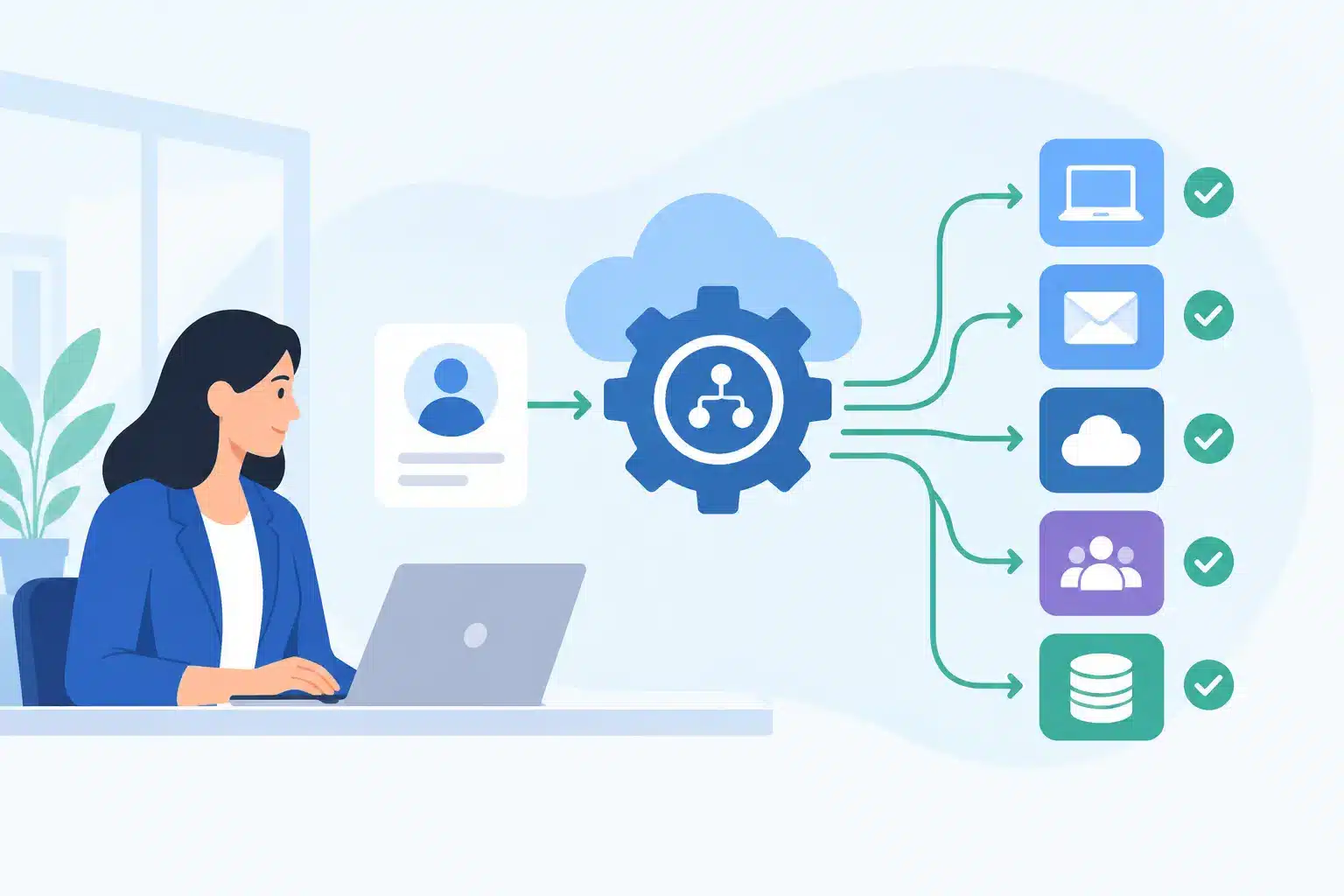
The right approach is to establish lifecycle triggers and control points for each population rather than forcing every identity through one generic process. Provisioning should be tied to approved roles, business attributes, and policy. Changes in manager, department, location, employment status, or assignment should trigger reevaluation of access. Termination and contract-end events need defined service-level targets, with high-risk access disabled immediately where possible.
Automation reduces delay and inconsistency, but it does not remove the need for exceptions. Emergency access, for example, may be necessary in clinical care or incident response. The control is not to prohibit it. The control is to make emergency elevation time-bound, logged, attributable, and subject to post-use review.
Role design should reduce entitlement sprawl
Role-based access control remains useful, especially when business roles map cleanly to predictable duties. But organizations should avoid treating roles as a complete answer. Highly granular roles can become another form of entitlement sprawl, while broad roles can conceal excessive access.
A practical model combines birthright access, role-based access, and policy-based decisions. Birthright access supports basic productivity. Roles assign common job-function access. Policies address context, such as location, device posture, risk level, or time of day. Attribute-based controls can add precision where static roles cannot reflect operational reality.
The test is simple: can a security team explain why a person has access, who approved it, and when it should be removed? If the answer depends on reconstructing years of manual grants, the model needs work.
Privileged Access Requires Separate Discipline
Administrative access carries a different level of risk. Domain administration, cloud tenancy control, database administration, production deployment, security tooling, and industrial control management should not rely on the same controls used for standard business applications.
Privileged Access Management should enforce individual accountability, credential protection, least privilege, and session visibility. Shared administrator accounts may remain necessary in some legacy systems, but their use should be mediated through vaulted credentials, controlled checkout, session recording where appropriate, and a clear link to the individual performing the work.
Just-in-time access is often a strong fit for regulated environments because it limits standing privilege. However, it depends on dependable identity data, well-defined approval paths, and operational resilience. A workflow that blocks an urgent production repair because the designated approver is unavailable can drive teams back to unmanaged emergency accounts. Design privileged workflows with escalation paths, break-glass procedures, and regular testing.
Machine identities deserve the same attention. Service accounts, API credentials, workload identities, SSH keys, and certificates often hold broad, persistent permissions. They are also commonly excluded from recertification because they do not fit a human-centric IAM process. Inventory them, assign owners, limit scopes, rotate secrets and certificates, and monitor their use. A service account with no owner is not an automation detail. It is an uncontrolled privileged identity.
Evidence Must Be Produced by the Operating Model
In regulated environments, evidence should be a byproduct of control execution, not a separate audit project. If approvals happen in email, reviewers maintain spreadsheets, and access changes are performed manually in consoles, evidence will be incomplete and expensive to collect.
Identity Governance and Administration capabilities can centralize access requests, approvals, provisioning records, access certifications, policy violations, and remediation tracking. The value is not merely documentation. A consistent system of record makes it possible to identify overdue reviews, orphaned accounts, toxic access combinations, and controls that are being bypassed.
Audit evidence should demonstrate more than completion. It should show the population in scope, the reviewer’s authority, the decision made, the remediation action, and the date that action was completed. For sensitive access, retain the context that explains why access was granted and whether compensating controls were required.
Metrics also matter. Mature programs measure dormant accounts, deprovisioning time, certification completion, overdue remediation, privileged standing access, orphaned service accounts, and exceptions past their expiration date. These measures give leadership a view of control health before an auditor or adversary identifies the gap.
Authentication and Access Decisions Need Context
Multi-factor authentication is a baseline expectation for sensitive systems, remote access, administrative functions, and access to regulated data. Yet MFA alone does not resolve the full access decision. A successfully authenticated identity may still be risky because of an unmanaged device, an impossible travel signal, an unusual request pattern, or a compromised session.
Conditional access policies should account for the sensitivity of the application and the risk of the requested action. Higher-risk activity may require phishing-resistant authentication, managed devices, step-up verification, or denial. The exact policy depends on the workforce, application portfolio, and tolerance for interruption. A call center, a hospital floor, and a cloud engineering team cannot be governed by identical user experiences.
The same principle applies to AI agents and automated workflows. An agent that can retrieve customer information, execute changes, or invoke APIs needs a distinct identity, narrowly scoped permissions, authentication controls, usage monitoring, and a human owner. Treating agent access as an extension of a developer’s personal account eliminates accountability precisely where it is needed most.
Make Exceptions Visible and Temporary
Exceptions are inevitable. Legacy applications may not support modern federation. A merger may introduce incompatible directories. A vendor may require named local accounts. The failure is not the existence of an exception. The failure is allowing it to become invisible and permanent.
Every exception should have a documented risk owner, compensating controls, expiration date, and remediation path. Central reporting should identify exceptions that are approaching expiration or have no active remediation plan. This turns risk acceptance into a governed business decision rather than an informal technical workaround.
Treat IAM as a Controlled Service
IAM programs often stall because implementation is treated as the finish line. In a regulated organization, identity controls must be operated continuously as systems change, users move, threats evolve, and regulations are updated. That requires clear service ownership, defined operational procedures, monitoring, policy maintenance, and a disciplined backlog for remediation.
The most effective programs align security, compliance, HR, application owners, infrastructure teams, and business leaders around a common access model. They do not try to perfect every application before improving the highest-risk access paths. They establish a control baseline, prove it in priority systems, and extend it with measurable discipline.
Start where the consequence of failure is highest: privileged access, regulated data repositories, critical production systems, and identities with broad or unclear authority. Build controls that people can operate under pressure, and make the evidence of those controls available before anyone asks for it. That is how identity security becomes a dependable part of regulatory resilience.