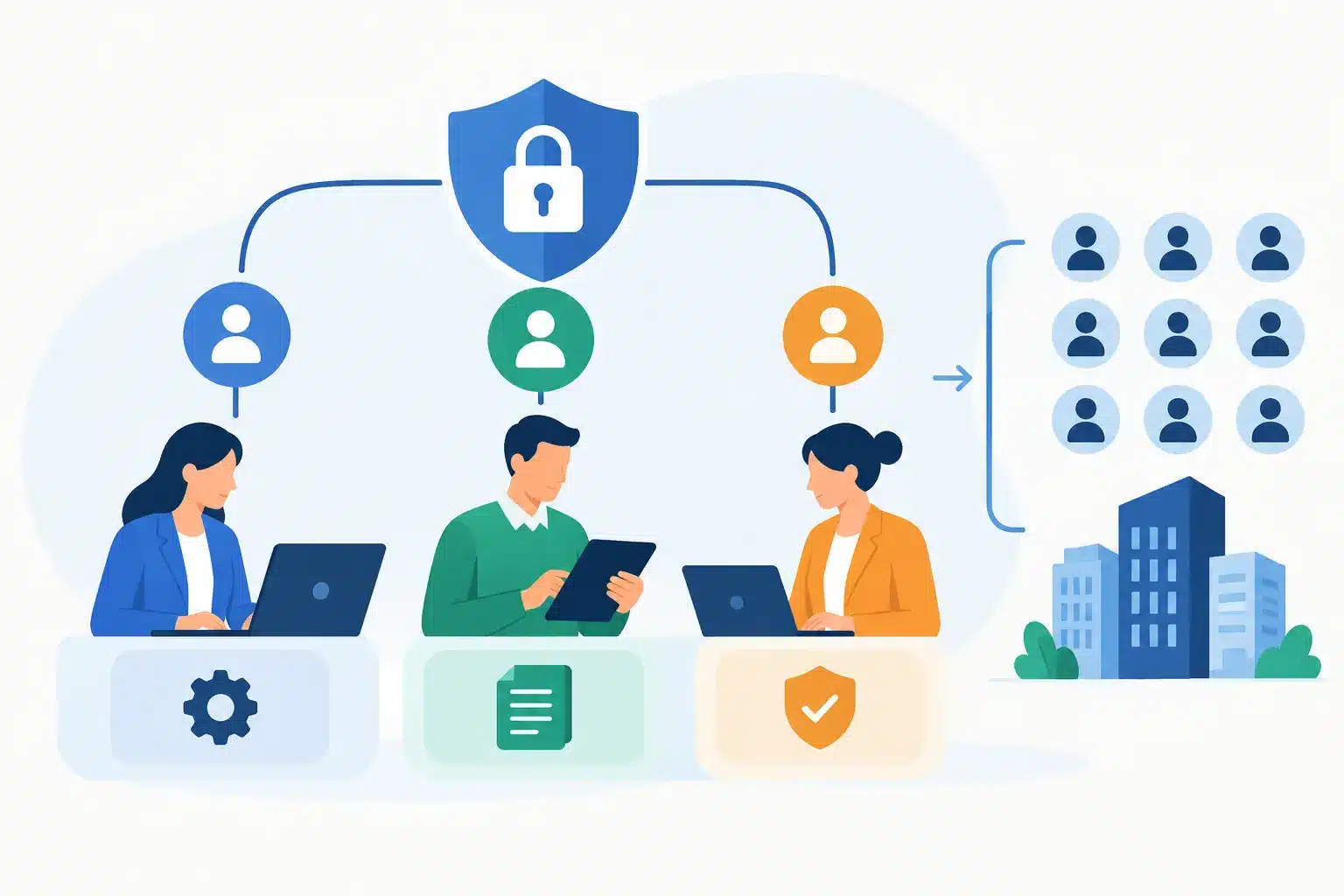
A workforce that signs in to dozens of cloud services should not need dozens of passwords, separate MFA enrollments, or disconnected access policies. That is the operational promise of workforce identity federation. It centralizes authentication through a trusted identity provider so employees can access approved applications with a consistent sign-in experience and security controls that can be measured.
But federation is not automatically secure because it reduces logins. It creates a trust boundary. If that boundary is poorly designed, a compromised identity provider, weak administrator control, stale application configuration, or unmanaged contractor account can become a broad access event rather than an isolated incident.
For enterprise security teams, the objective is clear: reduce credential exposure and user friction without creating blind trust across the application estate.
What Workforce Identity Federation Actually Changes
Workforce identity federation allows an application to rely on an external identity provider for user authentication. Instead of maintaining a local password database, the application receives an assertion or token confirming who the user is and, in many cases, which attributes or groups apply to that user.
The model commonly uses SAML, OpenID Connect, or OAuth-based patterns. The protocol matters, but the control model matters more. The identity provider becomes the policy enforcement point for authentication requirements such as phishing-resistant MFA, device posture, network conditions, and session risk. The application becomes a relying party that must correctly validate the federation response and enforce authorization appropriately.
This distinction is often missed. Federation answers, “Who authenticated this user, and under what conditions?” It does not automatically answer, “What should this user be allowed to do inside the application?” Authorization still requires sound role design, entitlement governance, and periodic review.
Federation Reduces Friction and Expands the Blast Radius
A well-operated federation program delivers meaningful security and operational gains. Employees use fewer passwords. Security teams can apply stronger authentication policies consistently. Offboarding can remove access at the central identity layer rather than relying solely on each application owner to act quickly. Help desk demand can decline when password resets and account recovery are consolidated.
Those gains come with a trade-off. A central identity provider is now part of the critical access path for finance platforms, clinical systems, engineering tools, administrative portals, and collaboration services. Its availability, recovery procedures, privileged access controls, and change governance directly affect business continuity.
The same is true of trust relationships. A misconfigured claim, an overly broad group assignment, or an application that accepts an unexpected issuer can grant access at scale. Federation should therefore be treated as production security infrastructure, not a convenience feature switched on during SaaS onboarding.
Build the Trust Boundary Deliberately
A secure federation architecture begins with an accurate inventory. Teams need to know which applications support federation, which protocol each application uses, who owns the integration, what accounts remain local, and which applications contain sensitive or regulated data. Without this baseline, organizations often discover shadow local accounts only after a federation outage or security investigation.
Separate Authentication From Authorization
Centralizing authentication does not justify centralizing every entitlement decision into groups. Large, multi-purpose directory groups are difficult to review and can create unintended access across applications.
Use the identity provider to establish identity and authentication assurance. Use each application, or an integrated governance platform, to manage roles and permissions at the level required by the business. High-risk access such as payment approval, production administration, patient data export, and security configuration should have explicit authorization controls, ownership, and review cycles.
Attribute and group claims should be minimal. Send only what the application needs. Excessive claims can expose unnecessary organizational data and make troubleshooting harder when access behavior changes.
Establish Strong Application Onboarding Standards
Every new federation connection should follow a defined security pattern. At minimum, validate the issuer, audience, redirect URIs where applicable, signing certificates, token lifetimes, and requested claims. Disable insecure fallback paths unless a documented exception is approved.
Local accounts deserve special attention. Some are necessary for break-glass access, service continuity, vendor support, or recovery from an identity provider outage. They should be limited, separately protected, monitored, and regularly tested. A local administrator account that is never reviewed is not a recovery control. It is an unmanaged persistence path.
Use a documented owner for every enterprise application integration. That owner is accountable for confirming the application configuration, supporting access reviews, and coordinating changes when certificates, domains, or identity platforms change.
Protect the Identity Provider as Tier-Zero Infrastructure
The identity provider and its administrative plane require stronger controls than ordinary business applications. Privileged administrators should use dedicated accounts, phishing-resistant MFA, just-in-time access where feasible, and privileged access management controls. Administrative sessions should be logged and reviewed for sensitive activities such as application creation, claim-rule changes, MFA policy changes, and new administrator assignment.
Avoid standing privilege for routine configuration tasks. Federation administrators can alter trust relationships that affect thousands of users. Their access should be governed with the same discipline applied to domain administration, cloud tenancy administration, and production security tooling.
Lifecycle Governance Is the Difference Between Federation and Control
Federation is most effective when it is connected to authoritative workforce data and identity lifecycle processes. Joiner, mover, and leaver events should drive access changes reliably, with clear ownership for exceptions.
For a new employee, the process may begin with an HR record, create an enterprise identity, assign baseline access, and require the appropriate authentication enrollment. For an internal transfer, it should remove obsolete application roles as deliberately as it grants new ones. For a departure, it should disable central authentication quickly, terminate active sessions where supported, and identify residual local, privileged, shared, and non-human access.
The timing depends on business risk. A standard SaaS application may tolerate a short provisioning delay. Privileged infrastructure access or regulated data systems may require immediate revocation and evidence that termination occurred. One policy rarely fits every access tier.
Contractors, subsidiaries, acquired companies, and external service providers introduce additional complexity. Their identities may originate outside the corporate directory, their lifecycle data may be incomplete, and their access may outlive the engagement. Federated business-to-business access can be appropriate, but it needs sponsor ownership, defined expiration, and controls that verify the external identity source remains trustworthy.
Monitor Federation as a Security Signal
A successful login is not proof of legitimate access. Federation telemetry can expose account compromise, configuration drift, and policy gaps when it is connected to security operations.
Monitor for impossible travel patterns, unusual device enrollment, repeated MFA failures, unexpected consent activity, privilege changes, new application integrations, modified claim rules, and authentication from unfamiliar locations or networks. Correlate these events with endpoint, network, PAM, and cloud activity. A sign-in anomaly becomes more meaningful when it is followed by a privileged role assignment or mass data download.
Logging must also support investigation. Retain enough identity, application, and administrator activity to reconstruct who changed a trust configuration, what policy applied at sign-in, and what access was granted. Many organizations collect authentication logs but lack visibility into the configuration changes that explain why an access decision changed.
Certificate lifecycle management belongs in this operating model. Federation certificates and signing keys expire. An expired certificate can interrupt access to a critical service; an unmanaged key can create a security exposure. Inventory ownership, expiration monitoring, rotation procedures, and emergency replacement steps before an incident forces the issue.
Test Failure, Not Just Login Success
Teams commonly validate federation by confirming that a user can sign in. That is necessary, but insufficient. Test the conditions that matter during disruption: identity provider outage, MFA service degradation, certificate rollover, terminated user access, lost device recovery, and emergency administrator access.
Business continuity controls should be intentional. Some applications may support limited local break-glass accounts. Others may require a secondary identity provider, alternate authentication policy, or a documented manual operating procedure. The right design depends on the application’s criticality, recovery objectives, and regulatory obligations.
Test these procedures with application owners, not only identity engineers. A technically valid fallback that cannot support payroll, clinical operations, trading, or plant operations is not a meaningful resilience plan.
A Practical Operating Model for Federation
Mature programs assign responsibilities across identity, security, application, and business teams. Identity teams operate the platform and authentication policies. Application owners validate integrations and authorization models. Security operations monitors suspicious activity. Governance teams certify access and manage policy exceptions. Business leaders remain accountable for who needs sensitive access.
This model should be supported by measurable controls: percentage of applications federated, number of remaining local accounts, MFA coverage, stale account remediation time, federation certificate expiration status, privileged administrator review completion, and application access review results. Metrics turn federation from a deployment project into an operating discipline.
IDENT1TY approaches identity security with that operational perspective. The goal is not simply to connect more applications to a sign-on platform. It is to establish a controlled identity layer that remains secure through workforce change, application growth, audit pressure, and evolving threats.
The next productive step is to examine one critical application path from end to end: authentication, claims, authorization, lifecycle events, logging, recovery, and ownership. The gaps found there usually reveal where workforce identity federation needs engineering attention first.