A terminated contractor still has active SaaS access. A service account has no confirmed owner. An administrator needs an emergency privilege elevation, but the approval path is buried in email. These are not isolated IAM problems. They are operating-model failures. Knowing how to reduce IAM complexity starts with treating identity as a controlled security discipline, not a collection of tools and ticket queues.
For enterprise teams, complexity usually arrives gradually. A new business unit adopts its own application stack. A merger introduces another directory. Cloud platforms create machine identities faster than teams can govern them. Compliance requirements add reviews, reports, and exceptions. The result is an environment where access may function day to day, yet few people can confidently explain who has access, why they have it, or how quickly that access can be changed.
Why IAM Complexity Becomes a Security Problem
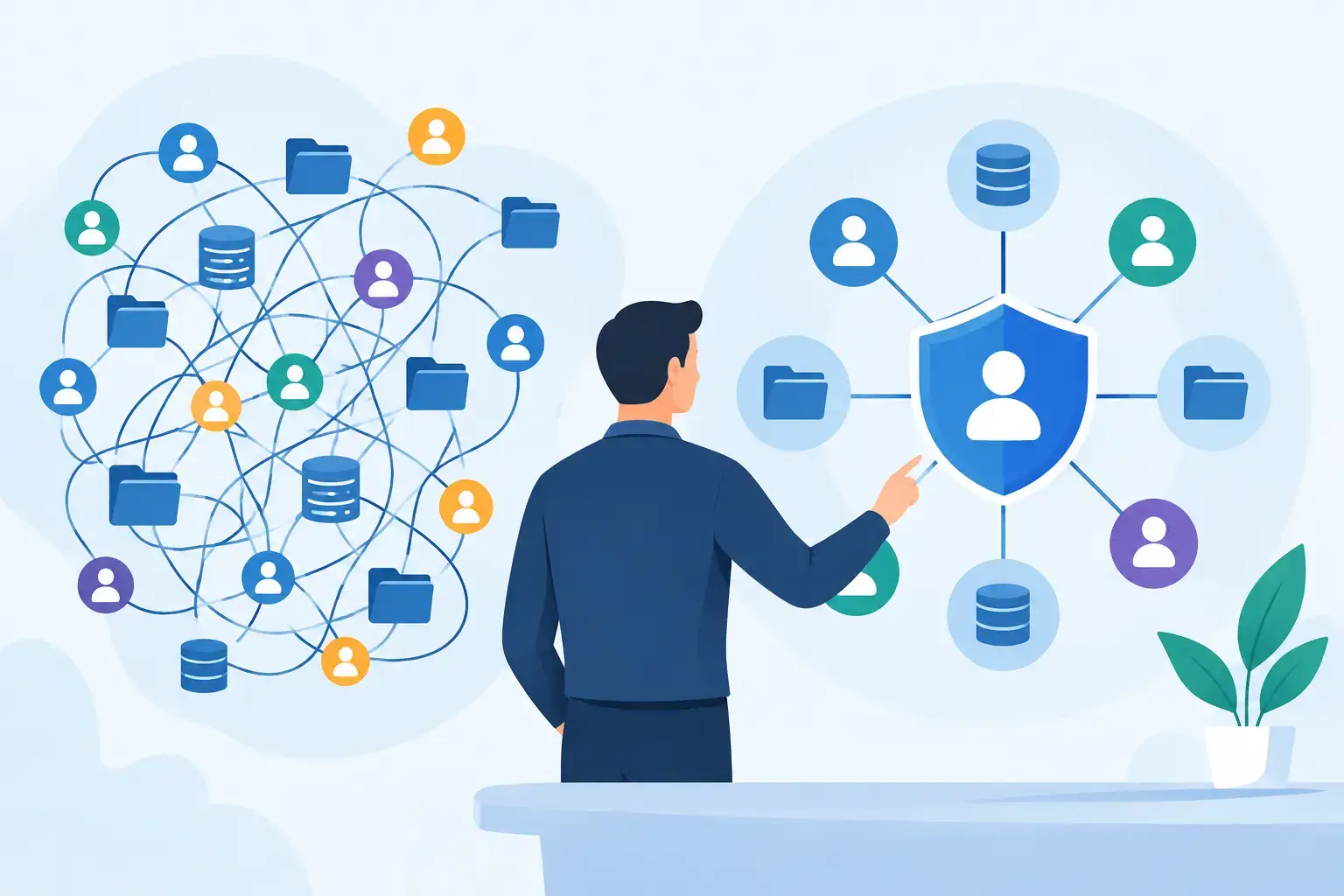
IAM complexity is often mistaken for a scale problem. Scale contributes, but the real issue is uncontrolled variation. Different identity sources, inconsistent joiner-mover-leaver processes, overlapping role models, manual approvals, and disconnected privileged access controls all create uncertainty. Uncertainty increases both security risk and operating cost.
When identity data is fragmented, access decisions become slower and less reliable. Administrators compensate with broad permissions, standing privileges, shared accounts, and manual workarounds. Auditors see incomplete evidence. Security teams lose visibility into toxic combinations of access. Users experience unnecessary friction and begin bypassing official processes.
The objective is not to force every system into one identical pattern. Some legacy platforms, regulated workflows, and operational technology environments require exceptions. The objective is to make exceptions visible, approved, time-bound, and governed. Control comes from deliberate standardization where it matters and documented variation where it cannot be avoided.
How to Reduce IAM Complexity: Start With the Operating Model
Technology rationalization matters, but buying another platform does not automatically simplify identity. First establish how identity decisions will be made, executed, measured, and sustained.
A practical operating model defines who owns identity data, who approves access, who manages roles, who operates integrations, and who accepts risk when a control cannot be applied. It also defines service expectations: how quickly access is provisioned, how emergency access is reviewed, and how stale accounts are remediated.
This work exposes a common gap. HR may be the authoritative source for employees, while contractors are maintained in a separate system and service accounts have no reliable lifecycle source at all. Without a clear source of truth for each identity type, automation simply moves inconsistent data faster.
Establish authoritative identity sources
Every identity category needs a defined system of record. That includes employees, contractors, partners, customers where applicable, privileged administrators, nonhuman accounts, certificates, workloads, and AI agents. The source does not have to be the same for all categories, but ownership and lifecycle events must be explicit.
Map the events that matter: creation, attribute change, transfer, suspension, reactivation, and termination. Then confirm which system triggers each event and which downstream systems must respond. A clean termination event that does not remove privileged access, API credentials, or certificates is not a complete termination control.
Design access around business roles, not application menus
Role-based access control can reduce complexity significantly, but only when roles reflect actual business functions. Many programs fail because they try to model every permission in every application from the beginning. That creates thousands of brittle roles that nobody can maintain.
Start with high-value populations and high-risk access paths. Build business roles for stable job functions, then use application-level entitlements where more granular control is necessary. Keep role ownership with the business, while IAM teams maintain the technical model and guardrails.
A role model should answer three questions clearly: what job function requires this access, who owns the decision, and what event should remove it? If the answer is unclear, the access is a candidate for review rather than automation.
Consolidate Controls Before Consolidating Every Tool
A single IAM platform is not always the right destination. Large enterprises may need multiple directories, specialized PAM tools, separate customer identity services, or distinct platforms for cloud and legacy environments. Forced consolidation can create migration risk without improving control.
Instead, consolidate the controls that matter. Standardize authentication policies, identity proofing requirements, privileged access workflows, access-review evidence, lifecycle triggers, and logging expectations. Integrate tools around a common identity architecture so security teams can see the full access path even when systems remain distinct.
Prioritize integrations based on risk and operational volume. A finance system with privileged access and frequent personnel changes should rank higher than a low-risk application used by a small static team. This prevents the program from becoming an endless integration exercise with no measurable risk reduction.
Remove Standing Privilege and Unmanaged Identities
Privileged access is where IAM complexity can quickly become material business risk. Shared administrator accounts, permanent elevated permissions, embedded credentials, and unmanaged service accounts make it difficult to attribute activity or contain a compromise.
Replace standing privilege with controlled elevation where practical. Require strong authentication, approvals appropriate to the risk, session monitoring, and time-limited access. Emergency access remains necessary in many environments, but it should be designed as a controlled process with post-use review, not as a permanent bypass.
Nonhuman identities require the same discipline. Service accounts, workload identities, API keys, certificates, and AI agents can access sensitive systems at machine speed. Each needs an owner, a purpose, scoped permissions, credential rotation or lifecycle controls, and monitoring. If no accountable owner exists, the identity should be remediated or retired.
Make Governance Continuous, Not an Annual Audit Event
Quarterly or annual certification campaigns can satisfy a compliance requirement, but they rarely provide sufficient control on their own. Managers often receive large access-review spreadsheets with little context and approve everything to meet a deadline.
Effective governance is event-driven and risk-based. Review access when a person changes roles, when a privileged entitlement is added, when an application becomes more sensitive, or when an identity has been inactive. Focus reviewer attention on access that presents meaningful risk: privileged rights, financial authority, sensitive health data, production environments, and toxic combinations.
Good governance also produces evidence as part of normal operations. Approval history, role ownership, policy exceptions, certification decisions, and remediation actions should be available without a manual scramble before an audit.
Measure Reduction in Complexity With Operating Metrics
Complexity is not reduced because a deployment is complete. It is reduced when identity operations become more predictable, measurable, and resilient. Track metrics that show whether control is improving.
Useful measures include the percentage of applications connected to authoritative lifecycle processes, time to deprovision terminated users, number of orphaned accounts, percentage of privileged access that is time-bound, access-review completion and remediation rates, and the number of unmanaged nonhuman identities. Also measure exceptions. A rising exception count may indicate that policies are poorly designed, integrations are failing, or business processes have changed.
Avoid vanity metrics such as total accounts managed unless they connect to risk reduction or service quality. A larger account count may reflect broader coverage, but it does not prove that access is governed.
Build for Change, Not a One-Time Cleanup
IAM environments change with acquisitions, new cloud services, workforce shifts, automation initiatives, and AI adoption. A one-time cleanup will not hold if the organization lacks architecture standards, ownership, and managed operational processes.
Treat the identity program as a lifecycle: assess the current state, define the target control model, remediate high-risk gaps, integrate in priority order, and continuously operate and improve. This is where specialized delivery matters. A capable partner can help connect strategy to implementation, but internal accountability for access decisions must remain clear.
IDENT1TY approaches identity security as an operational capability because lasting simplification depends on what happens after deployment: exception handling, integration support, access governance, privileged-session controls, and continuous measurement.
Reducing IAM complexity does not mean making identity simplistic. It means making critical access understandable, accountable, and controllable when the business needs to move quickly. Start with the identities and access paths that would cause the greatest damage if they failed, then build the discipline to keep them under control.