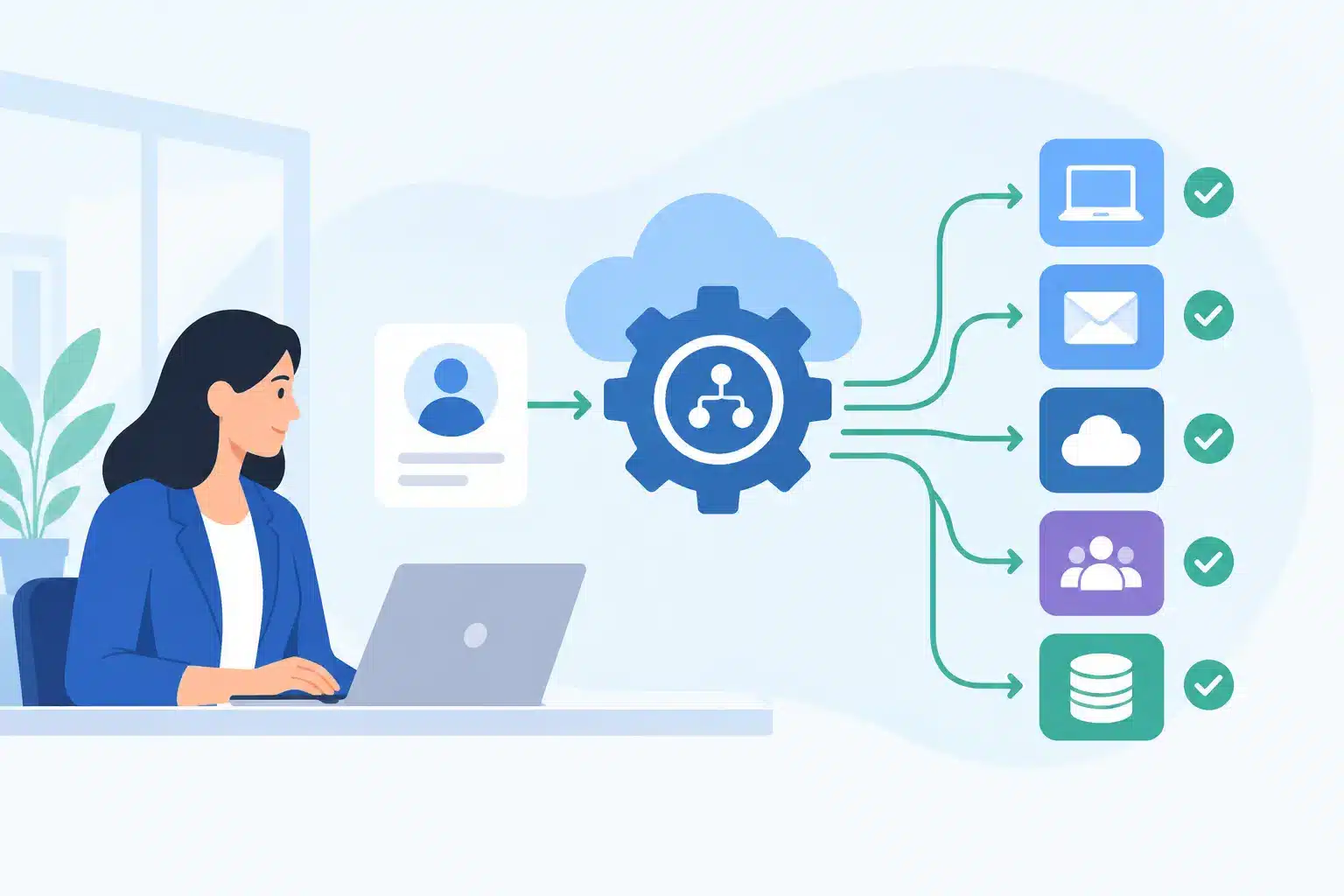
A large share of identity risk in 2026 will not come from a dramatic breach technique. It will come from normal operations that have outgrown their controls – too many accounts, too many entitlements, too many nonhuman identities, and too little confidence in who can access what. That is why identity and access management 2026 is less about buying another tool and more about regaining operational control.
For security leaders, this changes the conversation. IAM is no longer a directory problem or an SSO project. It is now the control plane for workforce access, privileged operations, machine identities, cloud administration, third-party access, and emerging AI agents acting on behalf of users and systems. If that control plane is fragmented, every audit, incident response effort, and modernization initiative becomes harder than it should be.
What identity and access management 2026 actually means
The most useful way to think about identity and access management 2026 is this: the scope of identity has expanded faster than most programs have matured. Many organizations have solid point capabilities. They may have MFA in place, a PAM vault deployed, lifecycle workflows partly automated, and governance reviews running on schedule. Yet the operating model behind those controls is often inconsistent.
That inconsistency shows up in predictable ways. Joiner-mover-leaver processes break at system boundaries. Privileged access is governed differently across on-prem, cloud, and SaaS platforms. Service accounts remain poorly owned. Certificates and keys are managed by separate teams with limited visibility. Access reviews are completed, but not always meaningful. AI-enabled tools introduce new identities and permissions before policy catches up.
The result is exposure that does not look dramatic in architecture diagrams but creates real risk in production. Security teams see orphaned accounts, excessive privilege, unmanaged secrets, duplicated controls, and gaps between policy intent and technical enforcement. Business teams see delays, exceptions, and access friction. Both are symptoms of the same issue: identity is being managed as a collection of tools instead of an operating discipline.
Why IAM programs are being restructured now
Three forces are pushing enterprises to revisit IAM more seriously in 2026.
First, the identity estate is no longer mostly human. Machine identities already outnumber users in many environments, and that ratio keeps growing. Workloads, APIs, bots, certificates, keys, and service principals all need lifecycle control, authentication, rotation, ownership, and monitoring. A human-centric IAM model cannot simply be stretched to cover them without redesign.
Second, privileged access has become more distributed. Traditional administrator accounts still matter, but privileged actions now occur across cloud consoles, CI/CD pipelines, DevOps tooling, SaaS admin panels, and automated workflows. The access path is broader, and in many cases less visible. That raises the standard for session control, credential handling, approval models, and analytics.
Third, AI is introducing a new layer of identity risk. AI agents and autonomous workflows can request data, trigger actions, use APIs, and inherit permissions. Whether those agents are embedded in enterprise platforms or built internally, they create new questions around authentication, delegated authority, activity logging, and policy boundaries. If an AI agent can act, then it needs identity controls equal to the sensitivity of its actions.
The core priorities for identity and access management 2026
Most organizations do not need a fresh IAM vision. They need a sharper set of execution priorities.
1. Establish a single control model across identity domains
Users, admins, vendors, applications, service accounts, certificates, and AI agents are often governed by different teams with different processes. That may be unavoidable from an organizational standpoint, but it should not mean separate control logic. The strongest programs define common principles for ownership, authentication strength, entitlement approval, periodic review, and deprovisioning across all identity types.
This does not mean every system must be standardized overnight. It means the control model should be clear enough that exceptions are intentional, documented, and limited.
2. Reduce standing privilege
Too many enterprises still treat privileged access as a static assignment. That model is increasingly difficult to defend. In 2026, the more mature approach is time-bound access, role scoping, session oversight, and stronger separation between standard and elevated identities.
There are trade-offs here. Highly regulated environments may push for stricter approval chains, while operational teams need access that does not slow down urgent work. The answer is not to choose security or efficiency. It is to design privileged workflows that fit the operational reality of the business while still limiting unnecessary exposure.
3. Bring machine identity under governance
This is where many IAM strategies still fall short. Certificates expire. Secrets are hardcoded. Service accounts remain shared. Ownership is unclear. Rotation is inconsistent. These are not edge cases. They are routine causes of outages and attack paths.
Machine identity needs inventory, lifecycle management, ownership assignment, and policy enforcement. For many organizations, this work starts outside the traditional IAM team and then creates overlap with security engineering, infrastructure, platform teams, and PKI administrators. That is exactly why governance matters. Without it, machine identity remains operationally critical but strategically unmanaged.
4. Treat identity data quality as a security issue
Bad identity data undermines every downstream control. If authoritative sources are inconsistent, role models decay. If application ownership is unclear, access certifications become superficial. If HR, ITSM, and directory data do not align, provisioning logic breaks.
Identity programs often underestimate this because data quality feels administrative. It is not. It is a prerequisite for enforcement, reporting, and accountability. In practice, many stalled IAM initiatives are data problems disguised as tool problems.
Identity and access management 2026 in the real enterprise
The practical challenge is not defining these priorities. It is applying them in environments that already contain years of technical debt, mergers, exceptions, and overlapping platforms.
A bank may need stronger workforce governance but cannot afford disruption to core access paths. A healthcare system may need better nonhuman identity control while still supporting legacy clinical applications. A manufacturer may need to govern third-party and plant access differently across regions. A public sector organization may face audit pressure that favors visibility first, automation second.
That is why IAM roadmaps in 2026 need to be phased and evidence-based. Programs fail when they attempt full transformation without first stabilizing ownership, architecture, and operating responsibilities. They also fail when they stay trapped in assessment mode and never progress to measurable control improvements.
A disciplined approach usually starts with four questions. What identities exist today, including machine and privileged identities? Where is access approval inconsistent or weak? Which systems create the highest business impact if access is misused or unavailable? And which controls can be operationalized within the current support model, not just deployed?
That last point matters. Many organizations have implemented capable technologies without building the workflows, support ownership, and policy rigor required to keep them effective. Identity security is not finished at go-live. It needs ongoing tuning, certification support, exception management, metrics, and adaptation as the business changes.
Where programs often go wrong
The most common mistake is treating IAM as an implementation project with a finish line. In reality, access controls degrade unless they are managed continuously. New applications arrive. Acquisitions introduce duplicate directories and incompatible role structures. Emergency access patterns become permanent. Admin teams create workarounds to keep operations moving.
Another mistake is over-indexing on user convenience without enough attention to assurance and governance. Good user experience matters. Poorly designed controls create shadow IT and exception sprawl. But convenience without clear ownership, logging, and privilege discipline creates risk that usually surfaces later, under pressure.
A third mistake is trying to solve strategy, architecture, deployment, and operations through separate providers and disconnected teams. That model often leaves gaps between design intent and production reality. Identity is too central to security and continuity for fragmented execution.
This is where a specialist operating model matters. Firms such as IDENT1TY are positioned around identity as a managed security discipline, not just a software stack. That distinction matters because the hardest IAM problems are rarely product selection alone. They sit in integration, governance design, control validation, and sustained operation.
What security leaders should do next
For 2026, the priority is not to make IAM bigger. It is to make it more controlled, more measurable, and more complete.
That starts with expanding the program boundary. If machine identities, certificates, service accounts, and AI agents sit outside your IAM governance model, the model is incomplete. It continues with access reduction. Standing privilege, duplicated admin paths, unmanaged exceptions, and unclear ownership should be treated as remediation targets, not accepted noise. And it requires operating discipline. Every critical identity control should have a named owner, defined metrics, and a support path when the business changes.
The organizations that get this right will not necessarily have the most tools. They will have the clearest control model and the strongest ability to enforce it across human and nonhuman access. In 2026, that is what mature identity security looks like: fewer blind spots, less standing risk, and a program that holds up under audit, incident pressure, and growth.
The practical opportunity is straightforward. If identity has become the control plane for your enterprise, then treating it like a one-time implementation is no longer enough. Build it to operate.