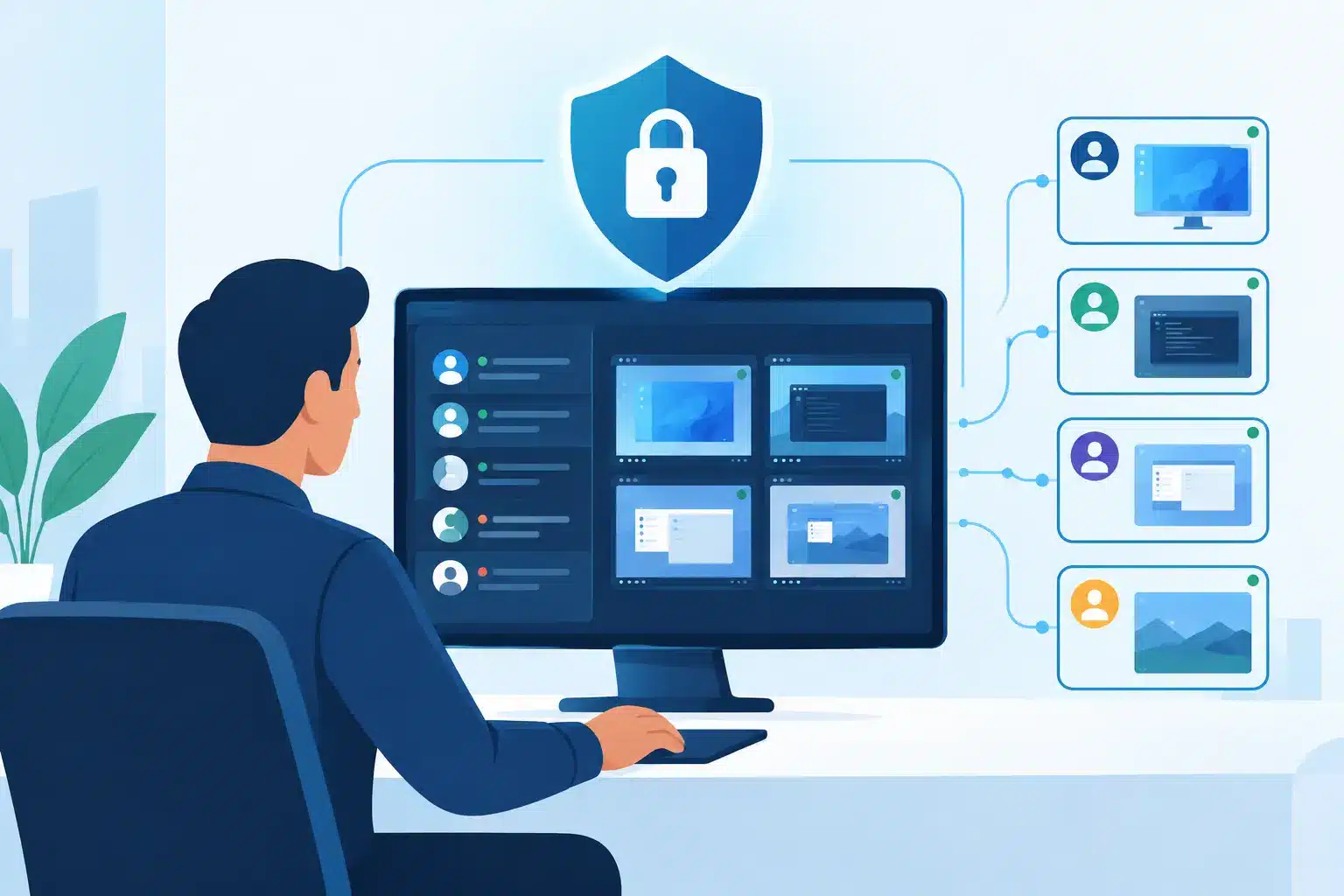
A privileged account can change a firewall rule, export sensitive records, disable an endpoint control, or alter a production database in minutes. The authorization may be legitimate. The outcome may not be. Privileged session monitoring gives security teams an accountable record of what happened during that access window, who performed it, what system was affected, and whether the activity matched the approved purpose.
For enterprises with hybrid infrastructure, cloud platforms, third-party support teams, and increasingly automated identities, that evidence is no longer optional. Password vaulting and multifactor authentication control entry. Session monitoring controls what can be seen, reviewed, and acted on after access begins.
Why privileged access needs session-level visibility
Privileged identities sit at the center of consequential operations. Administrators need elevated access to restore service, patch systems, manage identities, troubleshoot production incidents, and support critical applications. Restricting all privileged access until it becomes unusable is not a workable security model. The operational requirement is controlled access with clear accountability.
A log entry that shows an administrator authenticated to a server is useful, but incomplete. It does not explain which commands were executed, whether sensitive data was copied, whether configuration changes were authorized, or whether an external technician accessed systems outside the approved scope. Session-level visibility closes that gap.
This matters most when a security investigation needs answers quickly. During an incident, teams should not have to reconstruct activity from disconnected VPN logs, endpoint events, command histories, ticketing records, and cloud audit trails. A monitored session provides a direct record of the activity performed through a privileged access path.
The same visibility supports more routine control objectives. Security leaders can validate adherence to change procedures, investigate anomalous behavior, support internal audit requests, and identify operational patterns that create unnecessary risk. The goal is not surveillance for its own sake. The goal is defensible control over access capable of changing the business.
What privileged session monitoring should capture
The right implementation depends on the systems being protected and the operating model behind them. A database administrator working through a jump host creates a different evidence trail than a vendor accessing a cloud console or an engineer using an API with elevated permissions. Even so, an effective program should connect the session to a clear access narrative.
That narrative begins with identity. The organization must be able to establish the human or workload behind the session, the account used, the role or entitlement that authorized access, and the approval or ticket associated with the request. Shared administrative accounts without attribution weaken this model immediately, even when their passwords are vaulted.
It should also record the session context: source location, target system, protocol, start and end times, and the actions performed. For web and graphical sessions, recording may capture video-like replay. For SSH, database, or command-line activity, command logging and searchable metadata often provide more efficient investigation. Mature platforms can add real-time alerts for high-risk behavior, such as attempts to access restricted files, create new privileged users, or disable logging.
A recording alone is not the control. Teams need secure retention, access restrictions around the recordings themselves, and evidence that cannot be casually edited or deleted. Session data is sensitive. It may contain commands, configuration details, business data, or credentials inadvertently exposed on screen. Its protection must be designed with the same discipline as the systems it documents.
Monitoring is not the same as recording everything
There is a practical boundary. Recording every session indiscriminately can create storage costs, privacy concerns, and an unmanageable review burden. It can also lead teams to mistake data collection for risk management.
Risk-based coverage is usually more effective. Start with domain administrators, cloud tenant administrators, production database operators, security tooling administrators, and third parties with remote elevated access. Then apply stronger monitoring to high-value systems, sensitive data stores, and emergency access workflows. Lower-risk sessions may require metadata and event capture rather than full playback.
The policy should reflect business and regulatory obligations. Healthcare environments may need tighter control over sessions touching clinical data. Financial services organizations may prioritize trading, payment, and core banking platforms. Industrial organizations may need carefully designed controls that protect operational technology without disrupting maintenance windows or emergency response.
Where programs fail in production
The most common failure is treating privileged session monitoring as a feature to switch on after a PAM deployment. Technology cannot compensate for missing ownership, weak account hygiene, or access paths that bypass the controlled environment.
Administrators will use the fastest available route during an outage. If direct Remote Desktop Protocol access, unmanaged SSH keys, local admin accounts, or cloud-native break-glass credentials remain outside policy, monitoring coverage will be incomplete precisely when risk is highest. The program must identify and reduce those alternate paths without creating unacceptable operational delay.
Another failure is poor integration with operational workflows. If users must manually enter vague justifications, wait too long for approval, or work through unreliable session proxies, they will seek exceptions. The better approach is to integrate access requests with the existing service-management process, enforce time-bound entitlements, and make the approved route the most reliable path to the systems administrators need.
Third-party access deserves special attention. Vendors often require urgent connectivity, may work across multiple environments, and may not follow internal naming or identity standards. Assigning an individual identity, requiring multifactor authentication, brokering access through a controlled session, and limiting time and target scope are fundamental controls. A generic vendor account shared across a support team defeats attribution and complicates every investigation.
Build an operating model, not a recording archive
Effective monitoring requires defined decisions before an alert or investigation occurs. Security operations, infrastructure teams, application owners, compliance, and internal audit need agreement on who can view recordings, what triggers review, how long evidence is retained, and how findings are escalated.
A practical operating model answers several questions in advance. Which sessions require approval? What behaviors trigger immediate alerts? Who reviews high-risk activity and within what service level? How are emergency sessions authorized after the fact? When does a suspicious session become an incident, and how is evidence preserved?
This is where many organizations gain more value from a managed identity security capability than from technology alone. Platform administration, policy tuning, session storage management, connector health, and exception handling are ongoing responsibilities. The control degrades when recordings fail silently, target systems are not onboarded, or review queues are ignored.
At IDENT1TY, privileged access is treated as an operational security discipline: define the control objectives, integrate the technology with the access lifecycle, validate coverage, and maintain the service as infrastructure and threats evolve. That approach keeps session monitoring aligned with the environment it is meant to protect.
Measure control effectiveness with the right evidence
Leaders should avoid measuring success only by the number of recorded sessions. Higher volume can indicate stronger coverage, but it can also indicate broad collection with limited analysis. Better measures show whether the organization is reducing unobserved privileged activity and improving its ability to respond.
Track the percentage of privileged systems accessed through monitored paths, the percentage of privileged accounts tied to individual identities, and the number of direct access exceptions still in use. Measure how quickly teams can retrieve session evidence during an investigation. Review approval compliance, emergency access frequency, vendor session coverage, and the rate of alert findings that lead to validated action.
These metrics create a more useful conversation than asking whether PAM is deployed. They reveal whether the organization can prove control over its most sensitive administrative activity.
Preparing for cloud, automation, and AI agents
Privileged activity no longer occurs only through an administrator’s keyboard. Cloud automation, service accounts, API tokens, CI/CD pipelines, and AI agents can execute actions with broad operational impact. Traditional screen recording has limits in these cases, but the same control principles apply: attributable identity, narrowly scoped authorization, complete activity evidence, anomaly detection, and protected logs.
Organizations should extend their monitoring strategy beyond interactive sessions. Capture API activity, privileged workflow events, infrastructure-as-code changes, and agent actions where they affect critical systems. The evidence model must follow the access mechanism, not remain limited to legacy administrative protocols.
Start with the access routes that would cause the greatest damage if misused or compromised. Bring those routes under a controlled session architecture, connect each session to an accountable identity and business purpose, and test evidence retrieval before an incident demands it. When privileged activity is visible, attributable, and reviewable, security teams can act with confidence instead of reconstructing risk after the damage is done.