Last updated: July 2026
Identity governance has quietly become one of the most scrutinized controls in enterprise security. Auditors ask for it, regulators mandate it, and breach investigations keep tracing back to it. Yet many organizations run identity governance programs that pass their audits while access risk keeps growing underneath. This guide explains what identity governance is, how it works, why it matters in 2026, and how to make it actually reduce risk rather than just document it.
What is identity governance?
Identity governance is the practice of managing and controlling digital identities and their access rights across an organization, ensuring that the right people and machines have the right access to the right resources, for the right reasons, and only for as long as they need it. It combines policy, automated workflow, and evidence so that every access decision can be requested, approved, reviewed, and audited throughout an identity’s lifecycle.
In practice, identity governance answers a deceptively hard question: does every identity in the organization still hold access that is appropriate, justified, and documented? Answering it means continuously tracking who has access to what, why they were granted it, who approved it, and whether it should still exist. When that discipline breaks down, orphaned accounts, excessive privileges, and standing access accumulate silently, and they surface later as audit findings or breach entry points.
Identity governance is the core of the broader discipline of identity governance and administration (IGA). The two terms are often used interchangeably, with “administration” emphasizing the operational side (provisioning and fulfilling access) and “governance” emphasizing the control side (reviewing and certifying it).
Identity governance vs identity and access management
Identity governance is frequently confused with identity and access management (IAM), but they answer different questions. IAM controls authentication and authorization at the moment of access: who can sign in, with which credential, to which application. Identity governance controls whether the access an identity already holds is still appropriate over time: who reviewed it, who attested to it, when it expires, and how it gets removed.
The relationship is complementary, and neither works alone. IAM without governance produces orphaned accounts and standing privilege, because access is granted but never re-examined. Governance without IAM has no live access decisions to govern. A mature identity program runs both together, with IAM handling the front door and governance ensuring nobody keeps a key they should have handed back.
The core components of identity governance
A functioning identity governance program rests on a recognizable set of capabilities, each of which addresses a specific failure mode.
Access certification and review
Access certification is the periodic process in which managers or application owners confirm or revoke the access each user holds. It is the control auditors ask about most, and its purpose is to catch inappropriate access, orphaned accounts, and excessive privileges before they become exposure. Modern platforms automate campaign orchestration and route each review to the right approver, replacing the manual, spreadsheet-based reviews that invite blind approval.
Identity lifecycle management
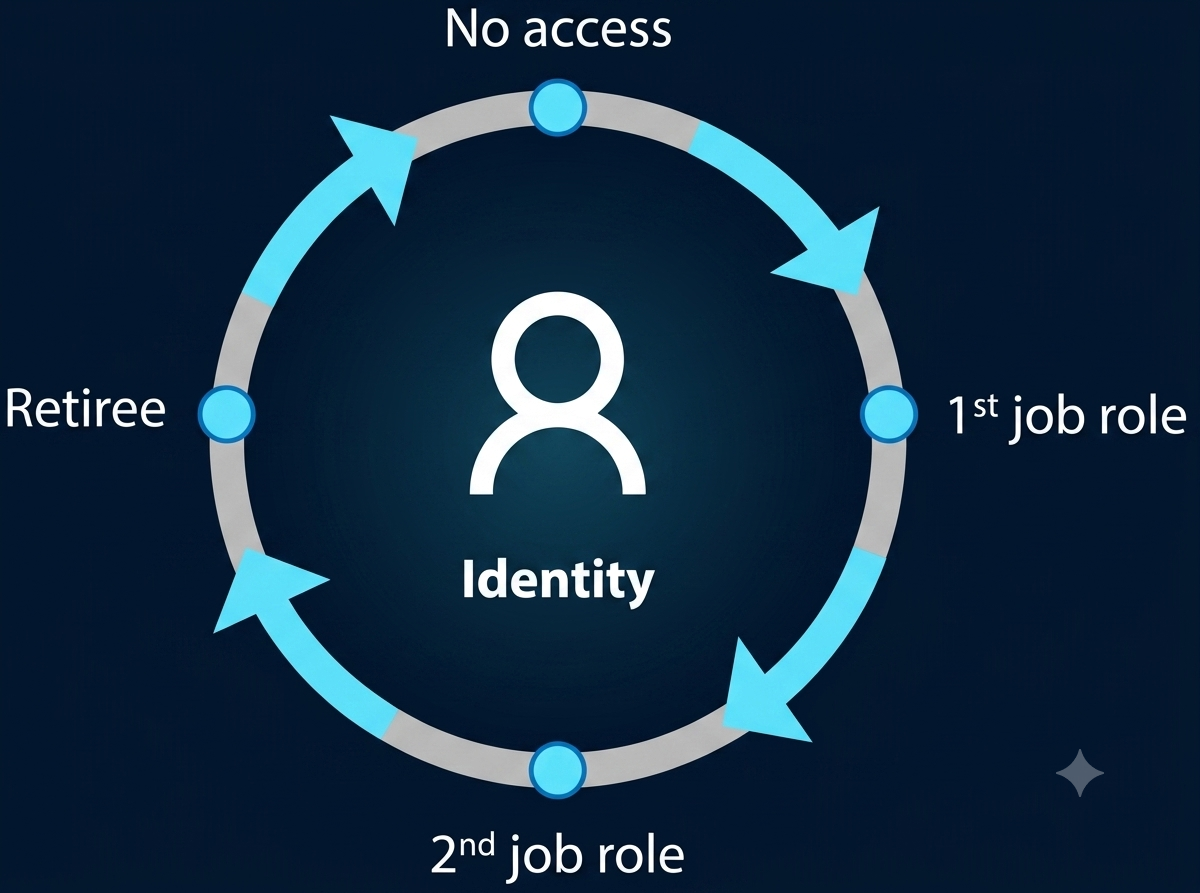
Lifecycle management automates the joiner, mover, and leaver process: granting appropriate access on day one, adjusting it when someone changes role, and revoking it immediately on departure. Weak lifecycle management is the single most common source of orphaned access.
Role management
Role-based access control groups permissions into roles built from real usage, so access can be granted and reviewed at the level of a job function rather than thousands of individual entitlements. Mature programs use roles as a control surface; immature ones use them only as a reporting layer.
Segregation of duties
Segregation of duties (SoD) prevents a single identity from holding conflicting permissions that could enable fraud, such as both creating and approving a payment. Governance detects and blocks these toxic combinations before access is granted.
Audit and reporting
Every decision, who reviewed what, when, and why, must be recorded in a defensible audit trail. This is what turns governance from an internal exercise into evidence a regulator or auditor will accept.
Why identity governance matters in 2026
Two forces have pushed identity governance from a compliance checkbox to a security priority. The first is scale. As cloud adoption and SaaS sprawl multiply identities and access paths, legacy spreadsheets and static tools cannot keep pace with the rate of change. The second is the explosion of non-human identities, which are reviewed far less often than human accounts, if at all.
The visibility gap is stark. Research indicates that only 5.7% of organizations have full visibility into their service accounts, which means governance often starts from an incomplete inventory, and you cannot review access you cannot see. At the same time, the perception of scale is badly miscalibrated: in Omada’s State of Identity Governance 2026 report, based on nearly 600 IAM and security leaders, practitioners most often estimate non-human-to-human identity ratios between 2:1 and 10:1, while executives report 50:1 or higher, and comprehensive discovery consistently proves the higher figures closer to reality.
The results are measurable where governance is done well. Organizations using automated IGA experience 40 to 60% faster audit cycles and report around 30% lower operational overhead in identity management, according to industry analysis. Governance that works does not just satisfy auditors, it shrinks the attack surface.
The audit trap: passing reviews while risk grows
The most important insight in identity governance for 2026 is that passing an audit and reducing risk are not the same thing. Boards are typically shown operational metrics, provisioning SLAs, certification completion rates, workflow throughput, that confirm identity workflows are executing, while the security indicators that reveal actual access exposure stay out of view.
This creates a dangerous illusion of control. A program can report 100% certification completion while reviewers rubber-stamp access they do not understand, and while orphaned accounts persist because service account offboarding was never part of the process. As one framing puts it, access review delay is a governance failure, not a scheduling issue: when reviews slip, the organization is not merely late, it becomes unable to prove that access still matches business need.
The test of real governance is simple. If teams can show completed review meetings but cannot show entitlement changes, the control is not working. Governance is effective only when the review results in measurable removal of unnecessary access, not just a documented signature.
Identity governance and non-human identities
Governance was designed around humans: employees with managers who respond to access review emails and who eventually resign or retire, triggering offboarding. Non-human identities break every one of those assumptions. A service account has no manager to certify its access, an API key does not complete a review, and a token has no departure date.
This is why compliance audits so often expose non-human identity problems before human ones. NHIs accumulate faster, are reviewed less often, and persist longer than human accounts, so dormant keys and over-privileged service accounts are easy to miss until an auditor asks for evidence. Extending identity governance to cover machine and AI agent identities, with the same ownership, review, and revocation discipline applied to people, is now one of the defining governance challenges of the year.
How to build effective identity governance
A governance program that reduces risk rather than just documenting it follows a consistent path. Start with discovery, building a complete inventory of identities and entitlements across directories, cloud, SaaS, and non-human identities, because governance built on partial visibility is governance in name only. Next, assign clear ownership: every entitlement needs an accountable owner who can judge whether the access is still justified, since a review with no accountable decision-maker is a checklist, not governance.
From there, automate certification and lifecycle so reviews run on cadence, route to the right approvers, and produce closed-loop remediation when access is revoked. Enforce segregation of duties and least privilege as active controls, not reports. Finally, measure the right things: track entitlement changes and access removed, not just workflow completion, so the program proves it is shrinking exposure over time.
Technology alone does not deliver this. The organizations that succeed pair the right platform with an operating model that defines ownership and accountability first. A dedicated identity governance and administration solution combined with expert integration turns governance from a documented process that passes audits into a living control that measurably reduces risk.
Frequently asked questions
What is identity governance in simple terms?
Identity governance is the practice of making sure every identity in an organization has appropriate, justified, and documented access, and that access is reviewed, certified, and removed when it is no longer needed, across the whole identity lifecycle.
What is the difference between identity governance and IAM?
IAM controls who can sign in and to what, at the moment of access. Identity governance controls whether the access an identity already holds is still appropriate over time, through reviews, certifications, and lifecycle management. Most enterprises need both.
What is access certification?
Access certification is a periodic review in which managers or application owners confirm or revoke the access each user holds. Automated certification replaces manual, spreadsheet-based reviews and produces the audit-ready evidence regulators require.
Why do identity governance programs fail?
They most often fail because they measure workflow completion instead of access risk. A program can report full certification completion while reviewers blind-approve access and orphaned accounts persist. Governance works only when reviews result in measurable removal of unnecessary access.
Does identity governance cover machine identities?
It must. Non-human identities now outnumber human ones by a wide margin, accumulate faster, and persist longer, yet they are reviewed far less often. Extending governance discipline, ownership, review, and revocation to machine and AI agent identities is a core 2026 priority.
Key takeaways
- Identity governance ensures every identity holds appropriate, justified, and documented access, reviewed and removed across its lifecycle.
- Passing an audit is not the same as reducing risk: governance works only when reviews measurably remove unnecessary access, not when they simply complete.
- With only 5.7% of organizations having full visibility into service accounts and non-human identities exploding, extending governance to machines and AI agents is now essential.