Last updated: July 2026
Every time a customer creates an account, logs into an app, resets a password, or agrees to a cookie banner, a system is making that possible. That system is customer identity and access management, or CIAM. It is a distinct discipline from the identity tools that manage employees, and getting it wrong costs breaches, compliance failures, and lost conversions. This guide explains what CIAM is, how it differs from traditional IAM, its core components, and why it matters in 2026.
What is customer identity and access management (CIAM)?
Customer identity and access management (CIAM) is the framework of tools and policies that governs how external users, customers, consumers, and partners, register, authenticate, and access an organization’s digital services. It manages the identities of the people who use your products, as opposed to the employees who work inside your organization.
CIAM unifies the concerns most product teams think about separately, sign-up flows, login screens, session management, consent, and privacy settings, under one coherent architecture. Its job is to balance two goals that often pull in opposite directions: strong security and a frictionless user experience. A customer who hits friction at login does not call your help desk, they abandon, so CIAM has to protect accounts without getting in the way. It is a specialized branch of identity and access management built for scale and experience.
CIAM vs IAM: what is the difference?
CIAM and traditional IAM share the same fundamentals, authentication, authorization, and identity management, but they are designed for fundamentally different users and priorities.
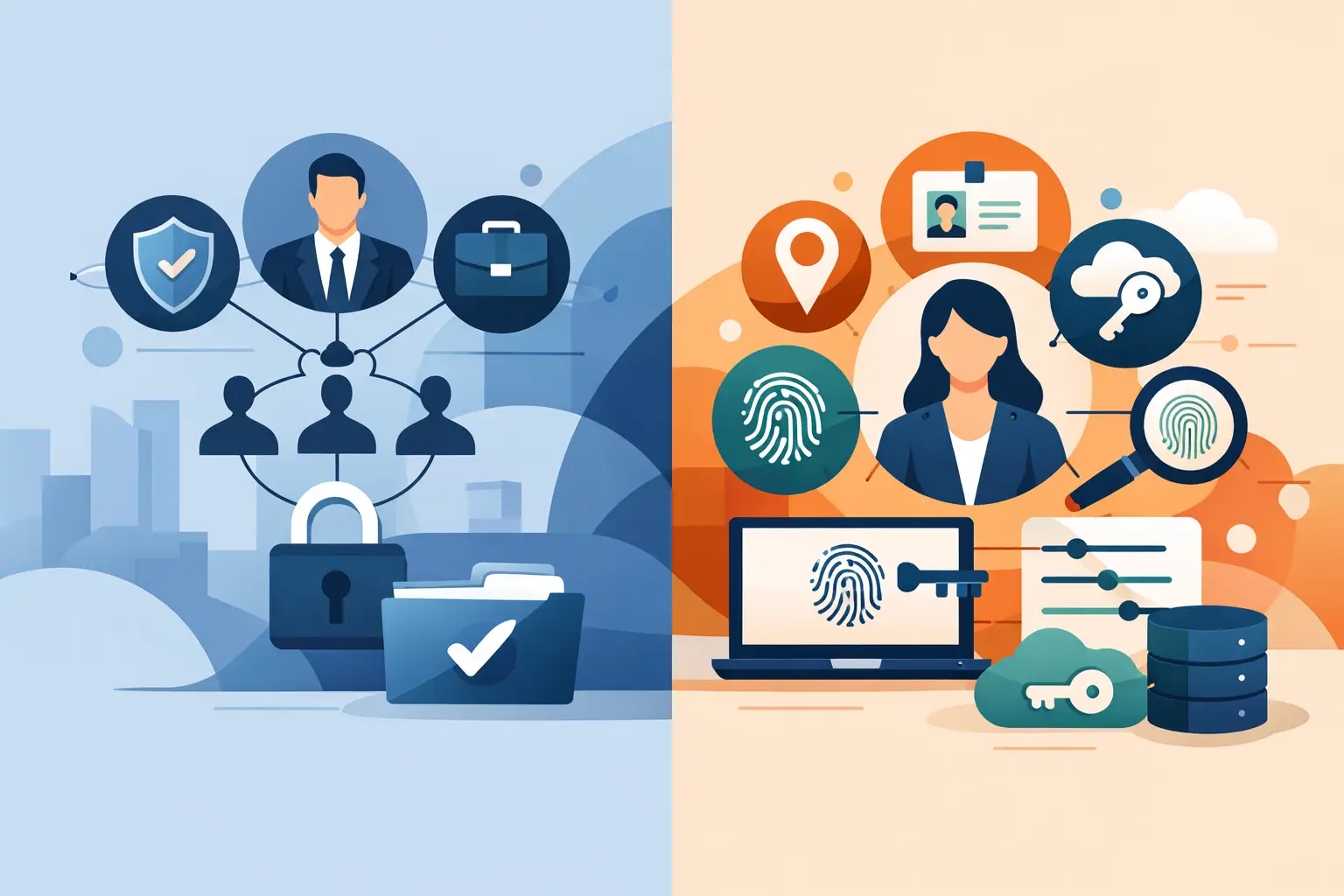
The clearest way to frame it: IAM manages internal users (employees and contractors) accessing corporate systems, while CIAM manages external users (customers and partners) accessing your digital products. That difference drives everything else. IAM handles thousands or tens of thousands of known users in structured roles, prioritizing operational governance and tight security. CIAM must handle millions or even billions of largely anonymous, self-registering users, prioritizing user experience and privacy compliance. Where workforce IAM assumes predictable, daily logins, CIAM must absorb irregular spikes during campaigns or seasonal events, and it faces a much larger attack surface because customers log in from less-secure personal devices.
The core components of CIAM
A CIAM platform brings together several capabilities that workforce IAM rarely needs.
- Flexible authentication. Beyond passwords, CIAM offers social login (Google, Apple), magic links, one-time passwords, biometrics, and increasingly passkeys, letting customers choose low-friction, secure options.
- Self-service. Registration, password resets, and profile updates that customers handle themselves, reducing support load and friction.
- Consent and preference management. Granular tools for customers to grant or revoke consent for data use, which is central to privacy compliance and largely absent from workforce IAM.
- Progressive profiling. Gradually collecting customer data over time rather than demanding everything at sign-up, which improves conversion.
- Unified customer profiles. Resolving fragmented identities into a single, accurate profile that powers personalization across web, mobile, and other channels.
- Fraud prevention at scale. Adaptive, risk-based authentication and real-time analysis to stop account takeover and credential stuffing.
Why consent and privacy are central to CIAM
The single biggest way CIAM differs from workforce IAM is its emphasis on privacy and consent. Because CIAM manages personal data belonging to customers, it must comply with a growing web of privacy regulations, GDPR and CCPA foremost, alongside newer regional laws like Brazil’s LGPD, India’s DPDPA, and Singapore’s PDPA, each adding data-residency and localized consent requirements.
Modern CIAM platforms handle this by centralizing consent management: capturing, storing, and enforcing each customer’s data-use preferences, and supporting right-to-erasure and data-access requests. Done well, this does more than tick a compliance box, it builds trust. Customers are more loyal to businesses that visibly protect their data and give them control over it, which turns a security function into a driver of engagement.
CIAM as a business driver
Unlike workforce IAM, which is primarily a security and operations function, CIAM directly affects revenue. It is the front door to your application, so its availability, speed, and ease of use shape conversion and retention. Reducing login and registration friction boosts sign-up rates; personalization built on unified profiles increases engagement; and integration with CRM and marketing tools turns identity data into actionable customer insight.
The stakes are large enough that CIAM has become a roughly $14 billion market growing near 18% annually, driven not by fashion but by the rising cost of getting identity wrong: breaches, friction, compliance failures, and lost conversions. For any organization with a digital customer channel, CIAM is now core infrastructure, not an afterthought.
CIAM in 2026: passwordless and AI
Two shifts define CIAM this year. The first is the passwordless transition, now firmly underway: passkeys and FIDO2 have moved from nice-to-have to a required evaluation criterion, driven by NIST recognition, broad platform support, and approaching regulatory deadlines for phishing-resistant authentication in several regions. Passkeys deliver both stronger security and higher login success rates than passwords.
The second is AI, on both sides of the fight. AI-generated phishing and deepfakes make customer-facing fraud harder to detect, while CIAM platforms respond with AI-driven adaptive authentication and real-time fraud analysis. A newer requirement is support for AI agent and machine identities, as agentic workflows begin to act on behalf of customers, extending CIAM beyond human users.
CIAM and the wider identity picture
CIAM does not stand alone. It sits alongside workforce IAM, which manages employees, and PAM, which secures privileged accounts, as part of a holistic identity security strategy that must cover both internal and external identities. CIAM is also what extends Zero Trust beyond the corporate perimeter to external customers, continuously verifying customer identity, device, and context on every access.
Most organizations eventually need both workforce IAM and CIAM, because internal teams need structured, governed access while customers expect smooth, private interactions. Getting each right, and integrating them coherently, is where identity expertise pays off. A dedicated identity and access management solution combined with expert integration ensures customer and workforce identity are secured to the same standard without compromising either experience or control.
Frequently asked questions
What is customer identity and access management (CIAM)?
CIAM is the framework that governs how external users, customers and partners, register, authenticate, and access an organization’s digital services. It balances strong security with a frictionless user experience and manages consent and privacy at scale.
What is the difference between CIAM and IAM?
IAM manages internal users (employees) accessing corporate systems, prioritizing governance and control. CIAM manages external users (customers) accessing your products, prioritizing user experience, scale (millions of users), and privacy consent. Most organizations need both.
What are the core features of CIAM?
CIAM includes flexible authentication (social login, magic links, passkeys), self-service registration and profile management, consent and preference management, progressive profiling, unified customer profiles, and fraud prevention at scale.
Why is consent management important in CIAM?
Because CIAM handles customers’ personal data, it must comply with privacy laws like GDPR, CCPA, and newer regional regulations. Centralized consent management captures and enforces data-use preferences, supports right-to-erasure, and builds customer trust.
Is CIAM part of IAM?
CIAM is a specialized branch of identity and access management focused on external customer identities, as distinct from workforce IAM (employees) and PAM (privileged accounts). All three are part of a holistic identity security strategy.
Key takeaways
- CIAM manages external customer identities, balancing strong security with a frictionless experience, while workforce IAM manages internal employees.
- Its defining features are consent and privacy management, massive scale, and low-friction authentication like social login and passkeys, which drive both compliance and revenue.
- Most organizations need both CIAM and workforce IAM, integrated as part of one identity security strategy that also includes PAM and extends Zero Trust to customers.