Last updated: July 2026
Most enterprises no longer run on one platform. They spread workloads across AWS, Azure, Google Cloud, and dozens of SaaS tools, and each one comes with its own identity system. Managing identity consistently across that fragmented landscape is one of the hardest security challenges organizations face today. This guide explains what cloud identity management is, why the cloud makes it complex, the technologies that solve it, and how to build a strategy that holds up.
What is cloud identity management?
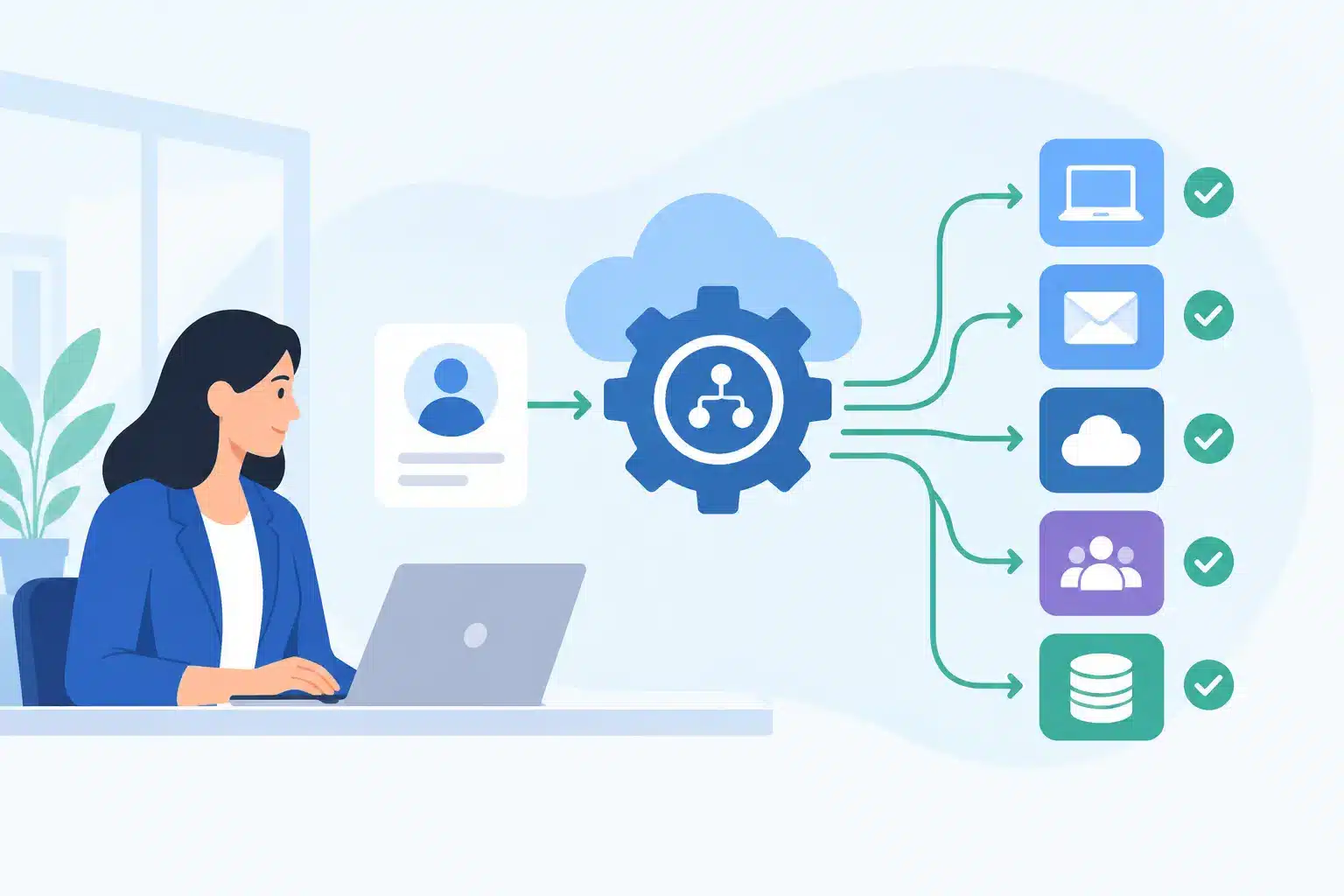
Cloud identity management is the framework of policies, processes, and technologies that ensures the right individuals and systems have appropriate access to resources across cloud environments. It extends the core principles of identity and access management, identity, authentication, and authorization, to public cloud platforms, SaaS applications, and hybrid infrastructure, so access can be controlled consistently no matter where a resource lives.
Unlike traditional identity management built for a single on-premises directory, cloud identity management has to work across multiple providers at once, each with its own identity framework and access model. Its goal is to unify authentication, access control, and governance under one consistent approach, rather than leaving each cloud to manage identity in isolation. It is a central part of any modern identity and access management strategy.
Why the cloud makes identity harder
The core difficulty is fragmentation. As organizations adopt multi-cloud strategies, each cloud provider introduces its own identity framework, access controls, and authentication standards. That fragmentation creates identity silos, and silos are where risk lives.
The concrete problems that follow are consistent across the industry: redundant credentials that users must juggle across platforms, inconsistent access policies that are enforced differently in each cloud, an expanded attack surface, and compliance gaps because no one has a single view of who can access what. Traditional identity models built around single-domain authentication simply cannot scale to this reality. Without a unified strategy, organizations are left with exactly the blind spots attackers look for: orphaned permissions, excessive privileges, and access that no one is reviewing.
Identity as a Service (IDaaS)
The most common answer to cloud identity complexity is Identity as a Service (IDaaS). IDaaS is a cloud-hosted identity platform, typically an identity provider (IdP) that delivers single sign-on, multi-factor authentication, and directory services from one console, and increasingly governance and lifecycle management too.
The appeal of IDaaS is centralization: it unifies authentication, access control, and governance across multiple clouds through a single administrative console, letting organizations enforce consistent policies everywhere instead of per-platform. It also shifts identity from an infrastructure investment to an as-a-service capability, so organizations buy the capability rather than build and maintain it. The trade-offs are real, added subscription cost, dependency on an external vendor, and integration effort for complex legacy environments, but for most enterprises facing a fragmented cloud landscape, IDaaS remains the pragmatic foundation.
Federated identity: the key mechanism
The technology that makes cross-cloud identity work is federation. Federated identity management lets users authenticate once through a trusted identity provider and gain access to multiple systems across different clouds and domains, without maintaining separate credentials for each.
Federation runs on open standards. SAML (Security Assertion Markup Language) enables single sign-on across different platforms, OpenID Connect (OIDC) adds an identity layer on top of the OAuth 2.0 authorization framework, and together they let one authenticated identity be trusted across AWS, Azure, Google Cloud, and SaaS applications. The payoff is significant: single sign-on across environments, unified policy enforcement, centralized lifecycle management, and streamlined compliance reporting, along with fewer passwords and therefore lower phishing exposure.
Federation is powerful but not risk-free. It does not mean blind trust: a misconfigured federation can create lateral-movement pathways for attackers, which is why it must operate inside a Zero Trust framework with strong authentication and continuous verification, not as a standalone shortcut.
The gap between SSO and governance
A common trap is assuming that once single sign-on and automated provisioning are in place, cloud identity is solved. It is not. Teams that federate access to the cloud often find they have solved authentication while leaving governance wide open: no approval workflows for access requests, no access reviews to prove compliance to auditors, no time-bound access (admin rights become permanent once granted), and no integration with HR systems to drive joiner-mover-leaver events.
In other words, SSO and provisioning answer how users log in and get access, but not whether that access is still appropriate or auditable. Closing that gap requires layering identity governance and just-in-time access on top of federation, so cloud access is not only convenient but continuously reviewed, time-limited, and provable. This is where cloud identity management connects to the broader disciplines of governance and privileged access.
The 2026 cloud identity threat landscape
Cloud identity is now a primary target. Credential-based attacks have risen sharply, driven in part by AI agents automating intrusion attempts, and attackers increasingly use AI-generated deepfakes and synthetic identities to defeat static authentication. In response, modern cloud identity platforms layer AI-driven adaptive MFA, device-trust assessment, biometrics, and behavioral analytics that trigger stronger verification only when risk is detected, going beyond static MFA to counter credential stuffing and prompt bombing.
Regulation is pushing in the same direction. Frameworks such as NIS2 and DORA demand stronger identity governance, continuous verification, and secure access workflows across cloud environments, making unified cloud identity management not just a security choice but a compliance requirement.
Building a cloud identity strategy
An effective approach combines several layers rather than relying on any one. Start with centralized IAM to enforce fine-grained permissions at the cloud resource level. Add SSO as soon as users need access to multiple systems, and introduce federation when collaborating across partners, subsidiaries, or multiple clouds. Enforce MFA everywhere, and move toward just-in-time access so standing privileges in the cloud are minimized. Crucially, complement all of this with a governance layer and continuous monitoring, so access remains appropriate, auditable, and secure over time.
Getting this architecture right across multiple clouds and legacy systems is demanding, and integration is where most projects struggle. A dedicated identity and access management solution combined with expert integration unifies identity across your cloud estate, closing the silos and governance gaps that fragmented, per-cloud identity leaves open.
Frequently asked questions
What is cloud identity management?
Cloud identity management is the framework that ensures the right individuals and systems have appropriate access to resources across cloud environments. It extends identity, authentication, and authorization to public clouds, SaaS, and hybrid infrastructure, unifying control across multiple providers.
What is IDaaS?
Identity as a Service (IDaaS) is a cloud-hosted identity platform that provides single sign-on, MFA, and directory services from one console. It centralizes identity management across multiple clouds, letting organizations buy identity capability rather than build and maintain it.
What is federated identity?
Federated identity lets users authenticate once through a trusted identity provider and access multiple systems across different clouds and domains without separate credentials. It relies on standards like SAML and OpenID Connect to make one identity trusted everywhere.
Why is multi-cloud identity so challenging?
Because each cloud provider has its own identity framework, access controls, and standards, which creates silos, redundant credentials, inconsistent policies, and compliance gaps. Traditional single-domain identity models cannot scale across this fragmentation without a unified strategy.
Is SSO enough for cloud identity management?
No. SSO and provisioning solve authentication and access delivery, but not governance. Without access reviews, approval workflows, time-bound access, and HR integration, access becomes permanent and unauditable. Cloud identity needs governance layered on top of SSO.
Key takeaways
- Cloud identity management unifies identity, authentication, authorization, and governance across multiple clouds and SaaS, solving the fragmentation that per-cloud identity creates.
- IDaaS and federated identity (via SAML and OIDC) are the core technologies, enabling single sign-on and consistent policy across AWS, Azure, Google Cloud, and SaaS.
- SSO alone is not enough: without governance, reviews, and just-in-time access layered on top, cloud access becomes permanent and unauditable.