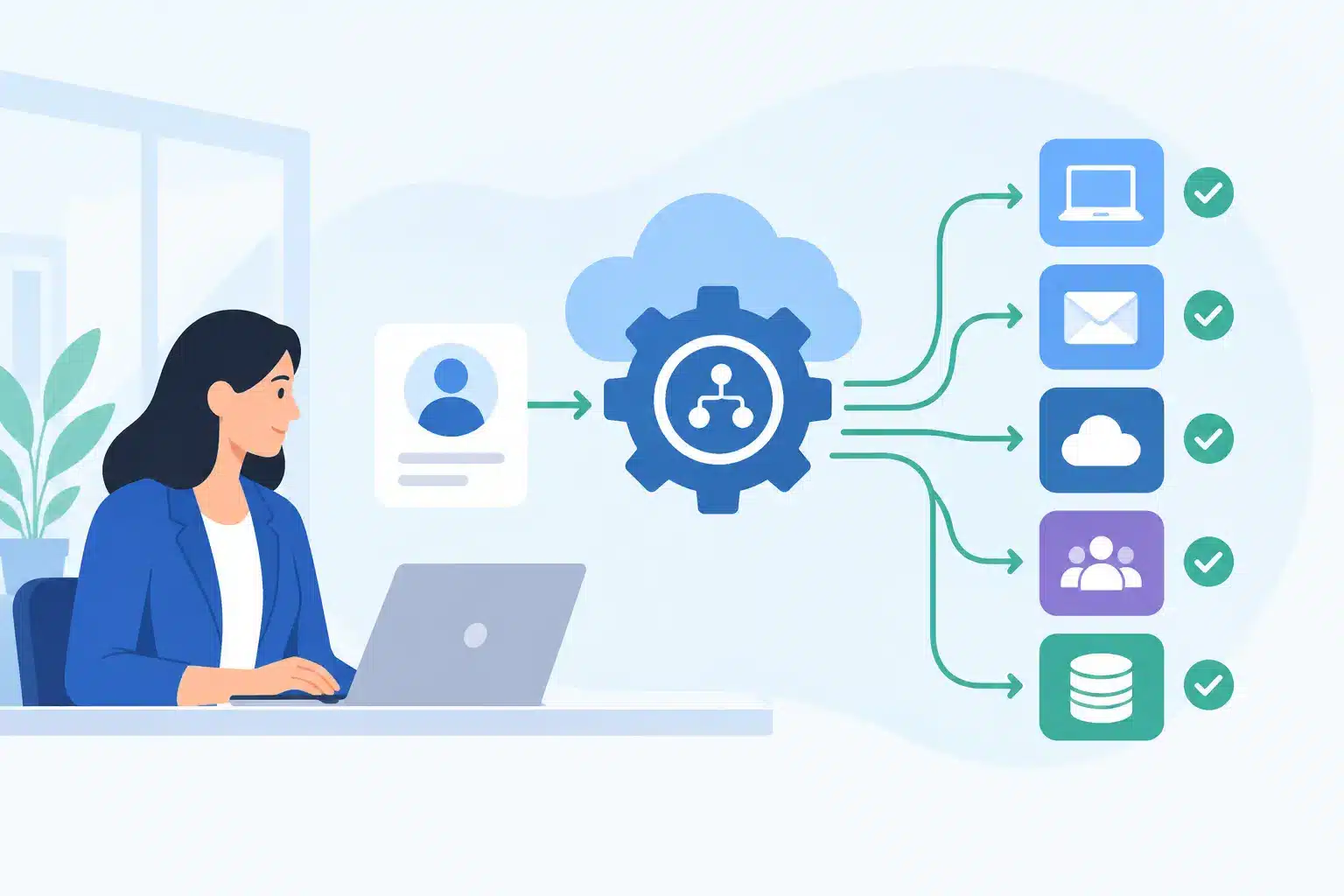
Most security incidents tied to access are not caused by a missing tool. They come from inconsistent decisions – who gets access, how it is approved, when it is removed, and whether anyone can prove it was controlled. An identity and access management system is meant to bring order to that problem, but only when it is designed as an operating model, not just a product rollout.
For mid-market and enterprise organizations, access is no longer limited to employees signing into a few business applications. It spans cloud platforms, legacy systems, third-party users, privileged administrators, service accounts, APIs, certificates, and increasingly non-human identities such as bots and AI agents. That makes IAM a control plane for business operations as much as a security function.
What is an identity and access management system?
An identity and access management system is the framework of technologies, policies, workflows, and governance controls used to verify identities and regulate access to systems, applications, and data. At a minimum, it answers four questions: who is requesting access, what should they have access to, how is that access approved and enforced, and when should it be reviewed or removed.
That definition matters because many organizations still treat IAM as a login project. They focus on single sign-on or multi-factor authentication and assume the job is largely complete. Those controls are essential, but they represent only one layer. A functioning IAM program also covers provisioning, deprovisioning, role design, lifecycle events, access reviews, segregation of duties, privileged access controls, and evidence for audit.
In practice, the system is rarely a single platform. It is usually a connected set of capabilities that must operate together under clear ownership and policy.
Why the identity and access management system has become a core security control
Attackers target identity because identity gives them reach. If they compromise a user account, a privileged credential, a machine identity, or a poorly governed service account, they can move through the environment without exploiting a traditional perimeter weakness.
That shift has changed the role of IAM. It is no longer an administrative convenience for onboarding users faster. It is a front-line security discipline tied directly to ransomware resilience, insider risk reduction, compliance readiness, and operational continuity.
For regulated industries, the pressure is even higher. Financial services, healthcare, energy, manufacturing, and public sector organizations need more than a record that access exists. They need evidence that access is appropriate, approved, monitored, and removed when conditions change. A weak joiner-mover-leaver process or a backlog of unresolved access certifications is not just inefficient. It creates measurable exposure.
The core functions that matter most
A mature identity and access management system usually starts with identity lifecycle management. When a user joins, changes roles, or leaves, access should change with them in a controlled way. If HR data, directory services, and target systems are not aligned, stale entitlements build up quickly.
Authentication is the next control point. Single sign-on improves usability and centralizes policy enforcement, while multi-factor authentication reduces the impact of stolen passwords. But authentication only proves the user at the door. It does not determine whether they should have broad access once inside.
Authorization is where many IAM programs get complicated. Role-based access can simplify control when roles are well designed, but many organizations inherit years of exceptions, custom entitlements, and local workarounds. That is why governance is critical. Access requests, approvals, certifications, and policy checks need to be traceable and enforceable.
Privileged access is another area that cannot sit outside the IAM strategy. Admin accounts, shared credentials, break-glass access, and service identities carry disproportionate risk. If PAM is disconnected from the broader identity model, blind spots remain.
Then there is the non-human side. Certificates, machine identities, application accounts, and AI agents increasingly participate in workflows that were once human-driven. They need ownership, lifecycle control, and policy enforcement as much as workforce identities do.
Where IAM programs usually break down
The biggest failure point is fragmentation. One team owns directories, another owns cloud identity, another manages PAM, and application teams approve access in email threads or ticket queues with little standardization. The result is a patchwork of controls that looks acceptable in architecture diagrams but breaks down in production.
The second issue is over-customization. Organizations often try to model every business exception in the initial design. That leads to long delivery cycles, brittle workflows, and governance processes that users bypass because they are too slow.
The third issue is treating deployment as the finish line. An identity and access management system degrades without operational ownership. New applications are added without proper onboarding, role models drift, orphaned accounts accumulate, and certification campaigns turn into repetitive administrative exercises instead of meaningful control checks.
This is why experienced organizations approach IAM as a program with architecture, implementation, and managed operations working together. The controls have to function under real business pressure, not only during a project phase.
How to evaluate an identity and access management system
A useful evaluation starts with risk, not features. Which access paths would cause the most damage if misused? Which identity stores are authoritative? Where are approvals weak, manual, or inconsistent? Which privileged and non-human identities lack clear ownership?
From there, the right design depends on the environment. A cloud-first enterprise with a modern SaaS stack may prioritize federation, conditional access, and rapid application onboarding. A regulated enterprise with legacy infrastructure may need stronger governance workflows, connector strategy, privileged session controls, and audit evidence across both modern and older systems.
This is where trade-offs matter. Centralization improves visibility and policy consistency, but it can slow adoption if application owners are not aligned. Strong approval controls reduce inappropriate access, but too much friction drives exception handling and shadow processes. Role-based models improve scale, but only if the organization is willing to rationalize entitlements rather than preserve every historical variation.
The best IAM designs are controlled, but realistic. They reduce risk without pretending the environment is simpler than it is.
What good looks like in production
A strong IAM capability is visible in day-to-day operations. Access requests follow defined paths. High-risk access triggers additional controls. Joiner, mover, and leaver events happen with minimal delay. Privileged access is vaulted, monitored, and time-bound where possible. Reviews are evidence-based rather than checkbox exercises.
Just as important, ownership is clear. Identity data sources are defined. Policy decisions have business and security accountability. Exceptions are documented and revisited. Metrics show whether the control environment is improving or slipping.
Good IAM also supports the business. It reduces manual administration, shortens onboarding time, improves user experience where appropriate, and gives security teams a cleaner way to enforce least privilege. Control and usability are not mutually exclusive, but they need to be designed together.
For many enterprises, that level of maturity requires outside expertise. The challenge is rarely buying another tool. It is integrating strategy, architecture, deployment, governance, and long-term operations into a system that holds up under scale. That is where a specialist partner such as IDENT1TY can add value – not by treating IAM as a one-time implementation, but by turning identity security into a structured operational capability.
The real question behind IAM
When leaders ask whether they need a better identity and access management system, they are usually asking a broader question: do we actually control digital access across the enterprise, or are we relying on assumptions, manual work, and partial visibility?
That is the standard worth using. If access decisions are hard to explain, harder to enforce, and nearly impossible to validate, the issue is not maturity on paper. It is exposure. The organizations that move ahead are the ones that treat identity as an operational security discipline and keep refining it as their users, systems, and machine identities continue to expand.
The most effective next step is not chasing a larger IAM footprint. It is establishing clear control over the access that matters most, then building from a foundation you can govern with confidence.