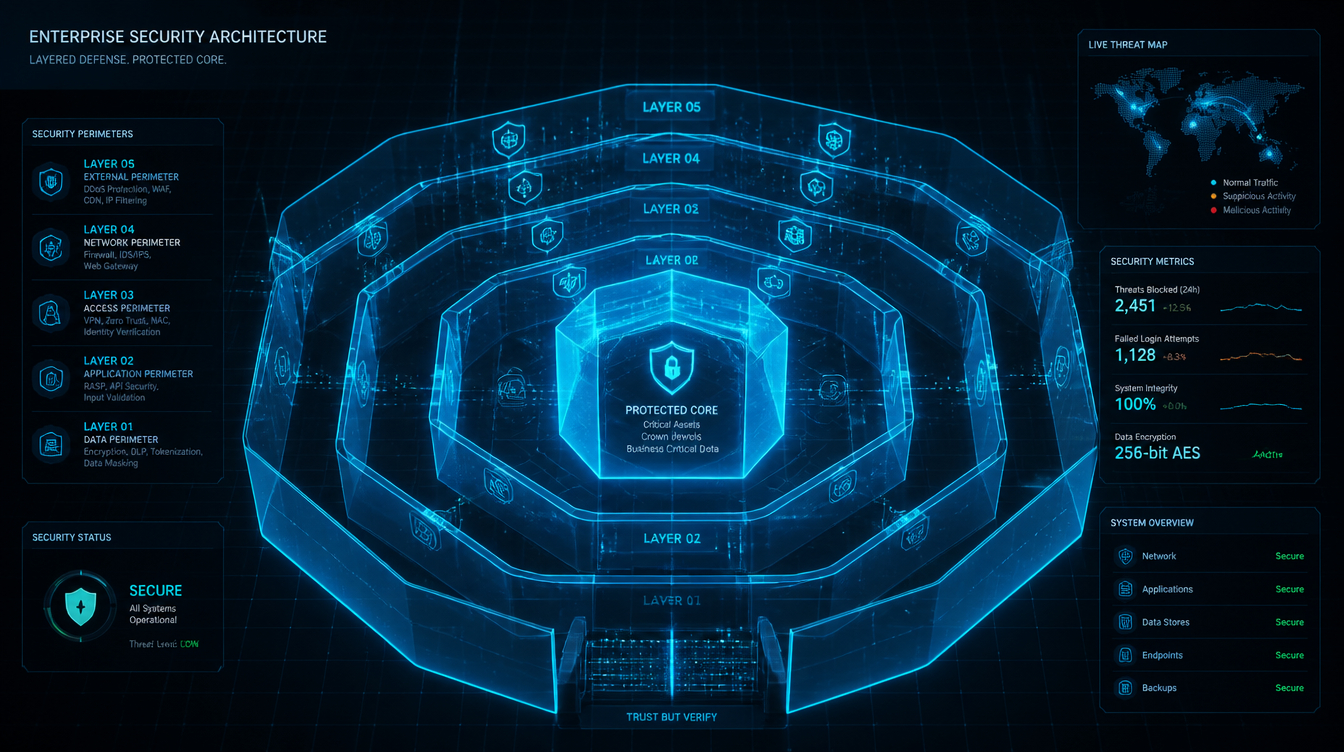
Zero Trust is not a product. It is not a project with a completion date either. It is a fundamental shift in how an organization controls access to its resources, and digital identity management is its central pillar. This guide explains what Zero Trust is, how it works in practice and what it means for your IAM and PAM architecture.
What “Never Trust, Always Verify” Actually Means
The traditional perimeter security model rests on a simple assumption: what is inside the network is trusted, what is outside is not. Zero Trust invalidates this assumption entirely. No identity, human or non-human, internal or external, benefits from implicit trust. Every access request is continuously evaluated based on precise contextual signals.
- User identity and authentication strength
- Device posture: managed, patched, compliant with security policy
- Location and time of the access request
- Sensitivity of the resource being requested
- Observed behavior during the active session
This is not a paranoid stance. It is the rational response to a factual reality: 80% of data breaches involve compromised credentials. The implicit trust granted to an account authenticated just once is the primary weakness attackers exploit.
The term Zero Trust was formalized by John Kindervag at Forrester Research in 2010, then institutionalized in the United States through OMB Memo M-22-09 in 2022, which mandates a Zero Trust architecture for all federal agencies. For US-regulated organizations, NIST SP 800-207 provides the definitive technical framework, while CMMC 2.0 embeds Zero Trust principles for defense contractors.
The Five Operational Principles of Zero Trust
Zero Trust translates into five concrete principles, applicable regardless of your existing technology stack.
| Principle | Operational Description | Associated Technologies |
|---|---|---|
| Verify explicitly | Every access request triggers identity, device and context verification | Strong MFA, conditional access, risk scoring |
| Least privilege access | Every identity receives only the rights needed, for only as long as needed | PAM, JIT, IGA, access recertification |
| Microsegmentation | Access limited to the specific resource, not the entire network | ZTNA, application firewall, SDN |
| Continuous monitoring | Trust is continuously re-evaluated throughout the session | UEBA, SIEM, behavioral analytics |
| Assume breach | Design the environment assuming an intrusion is already possible or underway | Exhaustive logging, segmentation, IR plan |
Why IAM Is the Core of Zero Trust Architecture
You cannot implement Zero Trust without robust digital identity management. All five principles ultimately depend on the ability to precisely identify who is accessing what, in what context and with what rights.
IAM Provides the Identity Foundation
Without a consolidated identity directory, without lifecycle governance and without consistent access policies across on-premises and cloud environments, Zero Trust remains an intention without infrastructure. IAM is the foundation everything else is built on.
PAM Secures the Most Critical Link
Privileged accounts, administrators, service accounts and third-party access, are attackers’ primary targets because they carry the broadest rights. Applying least privilege, JIT and behavioral monitoring to these accounts is the first Zero Trust initiative every organization should address. Visit our dedicated page to deploy your PAM solution.
IGA Maintains the Posture Over Time
Access rights drift. Users change roles, accumulate residual access and retain entitlements that no longer reflect their actual function. Without regular, automated access recertification through an IGA platform, any Zero Trust architecture degrades progressively over time.
Zero Trust in Practice: Where to Start
The most common mistake organizations make when approaching Zero Trust is trying to deploy everything simultaneously. This is a multi-year program. Every team that has successfully deployed Zero Trust follows a progressive, prioritized approach.
- Step 1: Map critical resources and identities. Identify the applications, data and systems whose compromise would have a major impact. These are the first targets for microsegmentation and enhanced access controls.
- Step 2: Consolidate IAM and deploy strong MFA. The identity directory must be reliable and MFA deployed across all critical access points. This is the baseline requirement for any Zero Trust architecture.
- Step 3: Apply least privilege to privileged accounts. Deploy a PAM solution with JIT for administrator accounts. This delivers the best impact-to-effort ratio in the early phases of a Zero Trust program.
- Step 4: Extend microsegmentation and behavioral monitoring. Once the fundamentals are in place, progressively extend controls across the full environment by integrating UEBA analytics into the SIEM.
- Step 5: Govern non-human identities. With the rise of agentic AI, service accounts, API tokens and autonomous agents must be brought into the Zero Trust perimeter. This is the central initiative of 2026.
Zero Trust and Regulatory Compliance
The major US and international security frameworks all converge on Zero Trust principles. If your organization operates under NIST, CMMC, SOC 2 or ISO 27001, a Zero Trust program is no longer optional.
| Framework | Zero Trust-Related Requirements | Organizations Concerned |
|---|---|---|
| NIST SP 800-207 | Definitive Zero Trust reference framework: identity verification, microsegmentation, continuous monitoring | Federal agencies, regulated enterprises |
| CMMC 2.0 | MFA, least privilege, access logging and audit requirements aligned with Zero Trust | DoD contractors and their supply chain |
| ISO 27001 (2022) | Identity management controls, strong authentication and access monitoring | Any organization seeking certification |
| DORA | Rigorous management of access to critical systems, exhaustive traceability, resilience testing | Financial entities operating in the EU |
How IDENT1TY Deploys Zero Trust
IDENT1TY designs and operates end-to-end Zero Trust architectures, leveraging the market’s leading platforms.
- CyberArk and BeyondTrust for PAM and privileged access management
- Okta for Workforce IAM and strong authentication
- SailPoint and Saviynt for IGA and access recertification
- Silverfort for agentless unified authentication across the full environment
Our value is not selling a technology. It is designing the target architecture that fits your specific context, industry, maturity level and regulatory constraints, then deploying it with the certifications that guarantee integration quality. CyberArk EMEA Delivery Partner of the Year 2023 and 2024. More than 100 active certifications. Operations across 17 countries.
Conclusion
Zero Trust is not another trend. It is the reference framework for access security over the next decade, mandated by US federal agencies, aligned with NIST and CMMC, and already deployed in the most mature organizations worldwide. Implementation starts with the fundamentals: consolidating IAM, securing privileged accounts with PAM and governing entitlements with IGA. It then expands progressively across the full environment, including non-human identities.
Want to assess your Zero Trust maturity and identify your priorities? Our experts are available for a 30-minute diagnostic, with no commitment. Talk to an IDENT1TY expert.