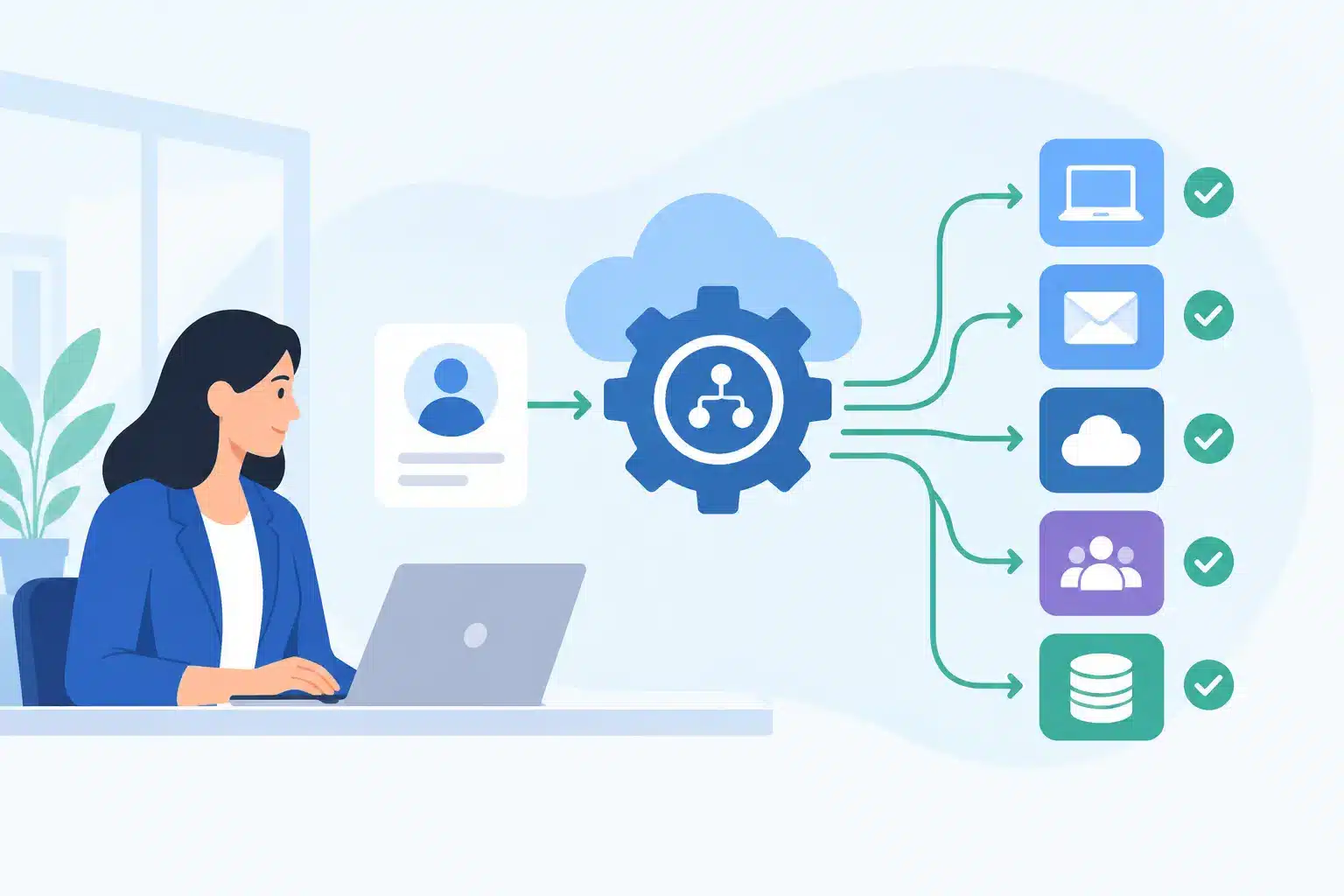
A user joins the company at 9:00 a.m., needs five systems by noon, changes roles three months later, and leaves a year after that. If access is still being granted through tickets, spreadsheets, and individual admin judgment, your security posture is already drifting. That is the practical answer to what is identity access control: the discipline of deciding who gets access, to what, under which conditions, and for how long – then enforcing that consistently.
Identity access control sits at the center of modern enterprise security because most attacks, failures, and audit findings eventually trace back to access. A user had too many permissions. A privileged account was shared. A contractor stayed active after the engagement ended. A service account was never reviewed. An AI agent or machine identity was trusted without enough policy around it. Identity is now the control plane for digital operations, which means access decisions are no longer an administrative side task. They are a security function.
What is identity access control in practice?
In practice, identity access control is the framework of policies, technologies, and operating processes used to authenticate identities and authorize access to applications, infrastructure, data, and administrative functions. The goal is straightforward: only the right identity gets the right access at the right time, with the right level of oversight.
That sounds simple until you apply it to a real enterprise. Identities are not limited to employees in Active Directory. They include contractors, vendors, privileged administrators, developers, customers, service accounts, machine identities, APIs, certificates, and increasingly AI agents acting on behalf of users or systems. Access is not limited to logging into one application. It spans SaaS, cloud platforms, VPNs, databases, servers, OT systems, and sensitive workflows that carry financial, operational, or regulatory impact.
This is why identity access control is broader than login security. Authentication matters, but strong authentication alone does not answer whether a user should have access, whether that access is excessive, whether it was approved correctly, or whether it should still exist today.
The core functions behind identity access control
Most identity access control programs are built around four core functions: identification, authentication, authorization, and governance. These functions work together, and weakness in one usually undermines the others.
Identification establishes who or what is requesting access. That may be a workforce user, a privileged account, a service principal, or a non-human identity. Authentication verifies that identity, often through passwords, MFA, certificates, tokens, or federation. Authorization determines what the identity is allowed to do after authentication succeeds. Governance provides the policy, review, lifecycle, and audit structure that keeps access aligned over time.
Without governance, access tends to accumulate. Without strong authorization models, users inherit broad permissions because it is operationally easier. Without clear identity classification, non-human and privileged access often escapes the same scrutiny applied to standard workforce users.
Why identity access control matters now
Enterprise environments have changed faster than many access models. Hybrid work expanded the perimeter. SaaS growth distributed business processes across dozens or hundreds of applications. Cloud adoption introduced dynamic infrastructure and machine-driven access patterns. Regulatory pressure increased expectations around accountability and traceability. At the same time, attackers learned that compromising an identity is often easier than bypassing hardened infrastructure.
That creates a hard requirement for control and visibility. Security teams need to know which identities exist, what they can access, how those privileges were assigned, and whether that access still serves a legitimate business purpose. If those answers depend on tribal knowledge or manual reporting, the organization is carrying avoidable risk.
There is also an operational dimension. Poor access control slows onboarding, creates approval bottlenecks, and burdens administrators with repetitive work. Strong identity access control is not only about blocking threats. It is also about reducing friction while keeping authority, accountability, and policy intact.
How identity access control differs from IAM, PAM, and IGA
Teams often use these terms interchangeably, but they are not identical.
IAM, or Identity and Access Management, is the broader discipline of managing digital identities and access across systems. Identity access control is one of its central outcomes. PAM, or Privileged Access Management, focuses specifically on elevated accounts and sensitive administrative access. IGA, or Identity Governance and Administration, addresses lifecycle management, approvals, certifications, policy enforcement, and auditability.
So when someone asks, what is identity access control, the best answer is not the name of a single product category. It is a cross-functional security capability delivered through multiple controls and platforms. In mature environments, IAM, PAM, IGA, directory services, MFA, and certificate management all contribute to access control. The exact design depends on the environment, the risk profile, and the level of operational maturity.
Common access control models
Not every organization uses the same authorization model, and that is where trade-offs start to matter.
Role-based access control, or RBAC, assigns permissions according to job role. It is easier to understand and scale than user-by-user assignment, but it often becomes bloated over time if roles are poorly designed. Attribute-based access control, or ABAC, makes decisions using attributes such as department, device posture, location, employment type, or data classification. It is more flexible, but usually more complex to implement and govern. Policy-based and risk-adaptive models add even more context, which can improve security but raise operational overhead.
The right model depends on the business. Highly regulated environments may need stronger separation of duties and review controls. Fast-moving engineering organizations may need more dynamic policy logic. Many enterprises end up using a hybrid approach because one model rarely fits every application and identity type.
Where identity access control breaks down
The failure points are usually familiar. Access requests are handled outside a central process. Joiner, mover, leaver workflows are inconsistent. Privileged accounts are exempt from normal governance because teams fear operational disruption. Service accounts are created for projects and forgotten. Access reviews become audit exercises instead of real control mechanisms.
Fragmentation makes all of this worse. One team owns directories, another owns cloud access, another manages endpoints, another controls business applications, and no one has complete visibility. You can have strong tools and still have weak identity access control if ownership, policy, and execution are disconnected.
This is why identity security has to be treated as an operating model, not a one-time implementation. The technology matters, but so do role design, approval logic, policy exceptions, recertification discipline, and managed operations after go-live.
What strong identity access control looks like
Strong identity access control is measurable. New users get the minimum access needed for their role. Role changes trigger automatic adjustments instead of access accumulation. Departures result in timely deprovisioning across connected systems. Privileged access is vaulted, monitored, approved, and reviewed. Non-human identities are inventoried and governed, not left outside the control boundary.
It is also defensible. If an auditor asks who approved access to a critical system, the answer should be clear. If a security team needs to review all privileged identities with standing access to production, that report should exist without weeks of manual effort. If an incident occurs, investigators should be able to reconstruct who had access, when, and why.
Just as important, strong control should not depend on perfect human memory. Mature programs reduce manual exceptions, standardize approvals, and integrate identity data with authoritative sources such as HR, ITSM, and cloud platforms.
Building an effective program
The first step is usually not buying another tool. It is understanding the current access landscape. Which identities exist, which systems matter most, where privileged access lives, and where governance is weakest. Many organizations discover they have overlapping platforms, inconsistent policies, and major blind spots around non-human identities.
From there, the focus should shift to control design. Define access models for high-value systems. Establish lifecycle ownership. Normalize approval paths. Separate privileged access from standard user access. Set review cadence based on risk, not convenience. Then align supporting technologies to that operating model.
Execution matters as much as architecture. An elegant access design that the business cannot operate will fail. A narrower design that is well governed and consistently enforced is usually more effective than an overengineered program that stalls in deployment. That is especially true in enterprises balancing compliance pressure, legacy systems, and ongoing transformation.
For organizations trying to reduce complexity while improving control, a specialist identity security partner can help connect strategy, integration, governance, and day-two operations into one workable model. That is often the difference between access control that exists on paper and access control that actually holds under pressure.
Identity access control is ultimately about discipline. Every identity, every entitlement, and every privileged path should be intentional. When that standard is in place, security improves, audits get easier, and the business moves with less hidden risk. The right question is not whether you have access control. It is whether you can prove it is working.